
This report presents the view that the Federal Reserve may once again be leaning hawkish at the wrong point in the inflation cycle. Over the last several years, markets have repeatedly experienced periods where policymakers and front-end rates repriced aggressively toward tighter policy, only for those expectations to later reverse as the underlying inflation impulse faded. In our view, the current setup may represent another version of that pattern. The recent inflation scare has largely been driven by a geopolitical energy shock rather than a clear broadening in underlying inflation pressure, yet SOFR markets continue to price additional tightening risk into year-end. If inflation continues to fade, real rates begin to top, and the Fed does not deliver the hikes currently priced into the curve, then the next major repricing may be the removal of hawkish policy expectations rather than another leg higher in rates.
The Recurring Fed Error
The current setup should not be viewed in isolation. Over the last several years, markets have repeatedly moved through periods where the Fed's reaction function appeared overly sensitive to temporary inflation impulses. Policy expectations repriced higher, the front end moved to reflect the possibility of tighter policy, and risk assets adjusted to the threat of higher real rates. In several cases, those expectations later reversed as the underlying inflation pressure faded, growth momentum softened, and markets moved back toward a less hawkish policy path.
In our view, this is a direct consequence of the Fed's post-2021 institutional scar tissue. The committee was late to recognize that the original post-COVID inflation cycle had become persistent. That mistake now influences how policymakers respond to future inflation shocks. The Fed is highly sensitive to appearing behind the curve again, and that sensitivity creates a different form of policy risk. A central bank that was too slow to respond to persistent inflation in 2021 can later become too aggressive in responding to temporary supply shocks.
This is the core of the recurring error. The Fed is not necessarily wrong because it cares about inflation. It is wrong when it treats every inflation impulse as if it carries the same persistence as 2021. A broad inflation regime driven by excess demand, wage pressure, and persistent services inflation may require tighter policy. A temporary commodity shock that raises headline inflation while simultaneously pressuring consumers is different. In that case, the shock itself tightens real incomes and demand, while the Fed risks adding additional tightening on top of it.
This pattern has already appeared multiple times in the last two years. Hawkish expectations rose during prior inflation scares, including tariff-related inflation concerns and other periods where markets extrapolated temporary price pressure into a more restrictive policy path. Those expectations later had to be reassessed as the underlying impulse faded. The current Iran-war energy shock may be another version of the same process. Markets moved quickly to price a more hawkish Fed, but the question is whether the inflation shock being priced is actually durable enough to justify that path.
The error today is not identical to 2021. It is closer to the mirror image. In 2021, policy remained too easy while inflation broadened across the economy. Today, policy expectations may be staying too tight while the inflation impulse is already beginning to fade. The Fed is not necessarily behind the inflation cycle in the same way it was then. It may now be behind the disinflationary turn that markets are beginning to detect beneath the surface.
The Current Inflation Shock
The recent inflation scare has been driven primarily by oil and energy prices rising on Iran-war fears. This matters because energy shocks can feed into inflation prints quickly. Oil transmits into gasoline, diesel, jet fuel, transportation costs, and broader energy-sensitive categories. When those inputs move higher, headline CPI can rise even if the underlying core economy is not experiencing a broad acceleration in pricing power.
This creates a familiar chain reaction. Oil prices rise, gasoline prices move higher, near-term inflation prints and inflation expectations worsen, the Fed becomes more cautious, and the front end of the curve prices a more hawkish path. The market does not need the Fed to actually hike for tightening to begin. The expectation of a hike can move nominal yields, lift real rates, pressure risk assets, and tighten financial conditions before the policy rate itself changes.
The problem is that this transmission mechanism can make the inflation scare look more durable than it actually is. Headline inflation is the most visible inflation measure, but it is also the most exposed to temporary energy swings. A one-time move higher in oil is not the same thing as a persistent inflation regime unless it begins feeding into core services, wages, shelter, expectations, and broader pricing behavior.
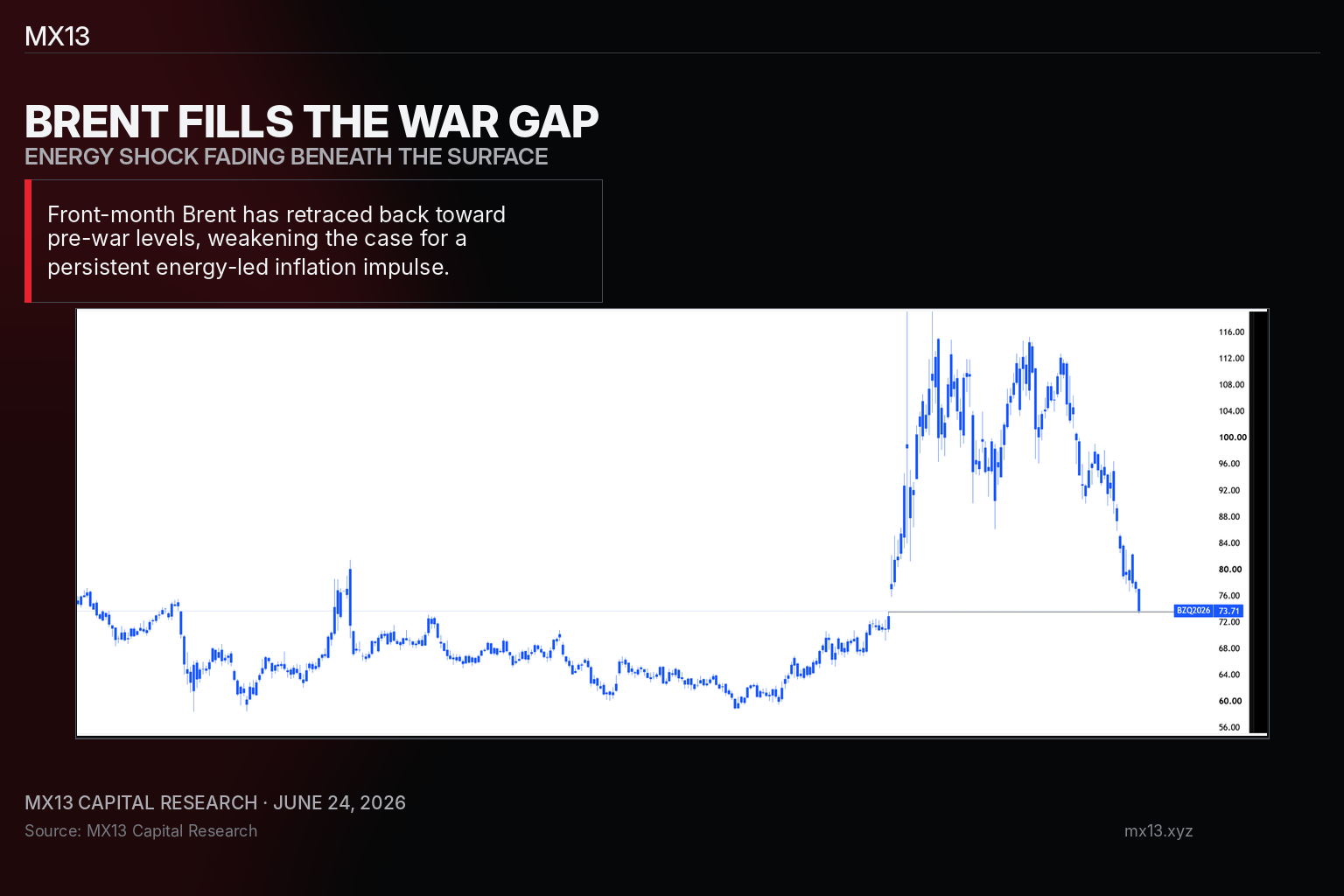
As of publication, our view is that the energy spike increasingly looks like it came and went. After the war-driven move higher, an agreement/MOU has been reached and oil prices have moved back down toward pre-war levels. That matters because the original source of the inflation scare has already started to reverse. If oil is no longer confirming the shock, then markets should be careful about extrapolating that shock into a new tightening cycle.
The key issue is second-round effects. The first-round effect is mechanical: higher energy prices lift headline inflation. The second-round effect is behavioral: companies pass through costs more broadly, workers demand higher wages, services prices accelerate, and inflation expectations become embedded. The Fed's fear is that the first-round shock becomes a second-round inflation process. Our view is that the evidence for that transition remains limited.
Core inflation and services inflation are the areas that matter most. If the energy shock were truly becoming persistent, it should begin showing up beyond the headline categories. So far, that does not appear to be the case. The recent move looks much more like a short-term energy spike than a renewed broad inflation regime. Energy moved first, headline inflation reacted, the Fed turned hawkish, and the curve priced the fear. But the core of the economy has not yet confirmed the same story.
In our view, the burden of proof is on the persistent-inflation case. If oil has already moved back toward pre-war levels and the data is not showing a durable feed-through into core and services, then the market may be pricing too much policy tightening off a shock that is already fading.
The Curve Is Too Hawkish
The clearest expression of the mispricing is in the front end of the curve. As of today, SOFR markets are pricing a path that implies additional tightening into year-end and early 2027, followed by eventual easing further out the strip. The terminal rate is around 4.125%, with roughly 49.5 basis points priced from effective fed funds to terminal. The market is also pricing roughly a 35% probability of a hike at the July meeting.
That is a major shift from the pre-war setup. Before the energy shock, the market was still leaning toward cuts. In parts of the curve, the move has gone from roughly 50 basis points of cuts priced before the shock to roughly 50 basis points of hikes priced after it. That is close to a 100 basis point swing in policy expectations across some contracts. For the front end of the rates curve, that is an enormous repricing in a short period of time.
The question is whether the data justifies that move. If the market were pricing a broad reacceleration in inflation, the move would make more sense. But if oil has already moved back toward pre-war levels and the shock is not feeding into core and services, then the front end may be pricing the Fed's reaction to inflation more than inflation itself.
This is the core mismatch. The curve is pricing a Fed that may still be reacting to the energy shock, while the underlying shock appears to be fading. The market is not simply pricing inflation. It is pricing the Fed's fear of inflation.
That distinction matters because fear can reverse quickly. If the Fed does not deliver the hikes currently priced into the market, then the front end does not need an aggressive cutting cycle to rally. It only needs the market to remove the hike premium that was recently added. The opportunity is not necessarily that the Fed becomes aggressively dovish immediately. The opportunity is that the current curve may be too hawkish relative to the inflation path that is actually unfolding.
Real Rates Are Already Doing the Work
Real rates are one of the most important parts of the current setup because they show how tightening can occur before the Fed actually changes rates. When nominal yields rise while inflation expectations stabilize or fall, real rates move higher. That raises the effective discount rate across the economy, tightens financial conditions, pressures long-duration assets, and increases the cost of capital.
This is why the current repricing can become self-limiting. The market has already moved to tighten conditions on behalf of the Fed. Higher real rates reduce demand, pressure financing conditions, and make it less likely that a temporary headline shock turns into persistent inflation. In other words, the rise in real rates is already doing part of the Fed's job.
This is materially different from 2021. In 2021, policy remained too easy while inflation was broadening. Today, real rates have already moved higher into the shock. The system is tightening in response to the inflation scare before the Fed even delivers another hike.
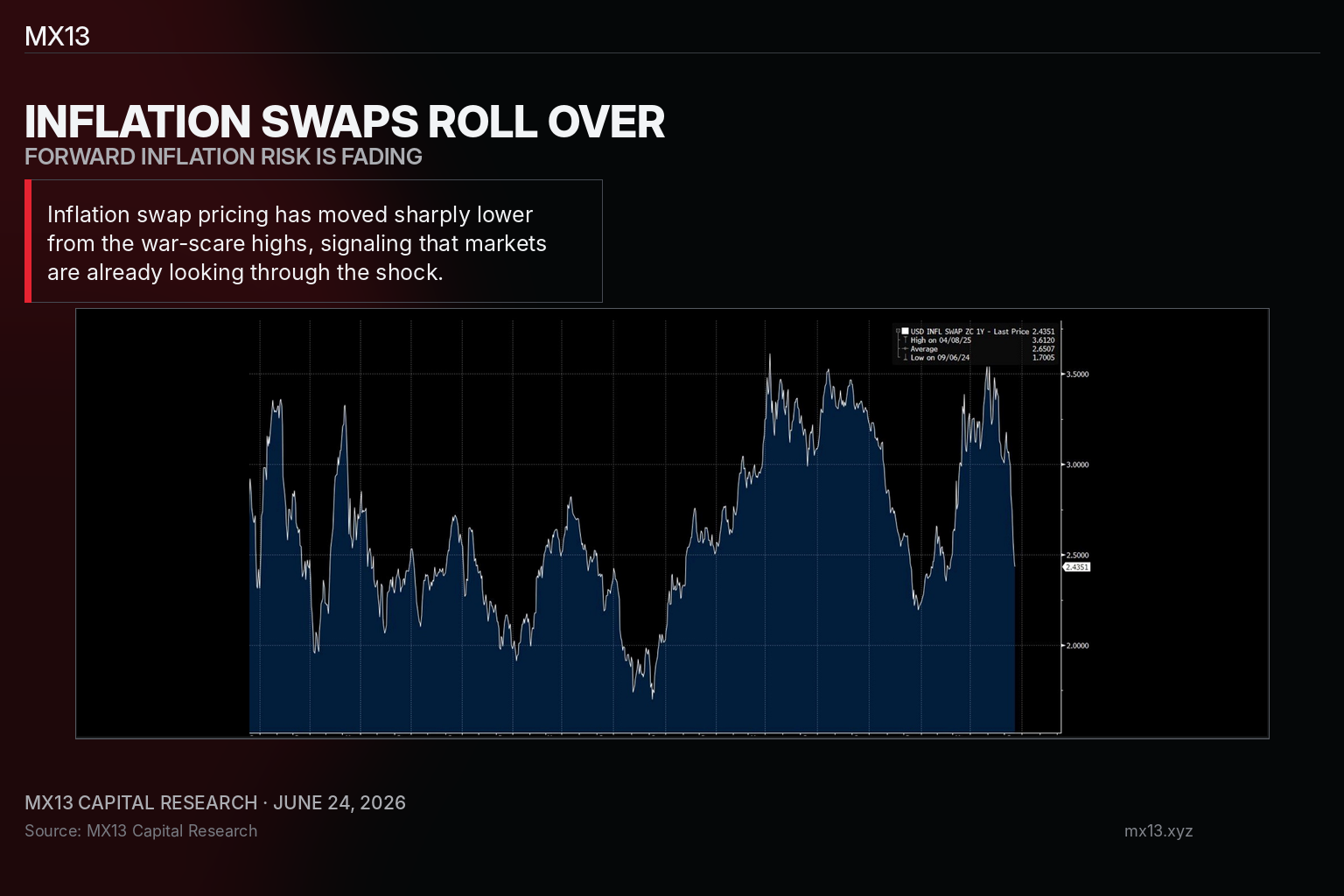
Inflation swaps appear to be smelling this out as well. As real rates rise and oil gives back the war-driven spike, inflation expectations have started to move lower. That is the market's way of saying that the shock may be fading rather than embedding. If inflation expectations continue moving lower while the front end still carries hike premium, then policy pricing becomes increasingly misaligned with the inflation signal.
In our view, this supports the idea that real rates are closer to a local peak than the beginning of a new sustained tightening regime. The Fed may already be receiving the tightening effect it wants through markets. Another hike would risk adding policy pressure after the shock has already started to reverse.
Not a Regime Break
This report is not making a broad recession call or arguing that the market is entering a disorderly risk-off regime. The cleaner interpretation is that markets are moving through a positioning adjustment caused by a rapid repricing in policy expectations. That distinction matters because a rates mispricing can exist without requiring a full macro breakdown.
Recent equity weakness appears more consistent with rotation, degrossing, and adjustment to higher real rates than a true liquidity break. Inflation-sensitive trades have started to fade, crowded areas of the market have seen pressure, and risk assets have had to digest the possibility of a more hawkish Fed. That is not the same thing as the cycle breaking.
In fact, if the thesis is right, this adjustment may eventually become fuel for higher prices. If markets have already derisked around the possibility of renewed tightening, but the Fed does not deliver those hikes, then the removal of hike premium can support both rates and risk assets. The pressure created by the hawkish repricing can become the setup for the next move higher once the market realizes the inflation shock is fading.
The cycle is not necessarily fracturing. Positioning is. The inflation trade is unwinding, the curve remains too hawkish, and risk assets are adjusting to the temporary pressure of higher real rates. That is not a full macro break. It is a dislocation.
Trade Implications
The first expression is fading the priced hikes. MX13 Capital is interested in expressing this primarily through SOFR futures, focused on the end-of-2027 contracts, where a move back toward baseline funding expectations should benefit if the current hawkish repricing fades. We are also expressing the same view through prediction market wagers on no additional rate hikes this year, which provides a cleaner binary expression of the policy-path view.
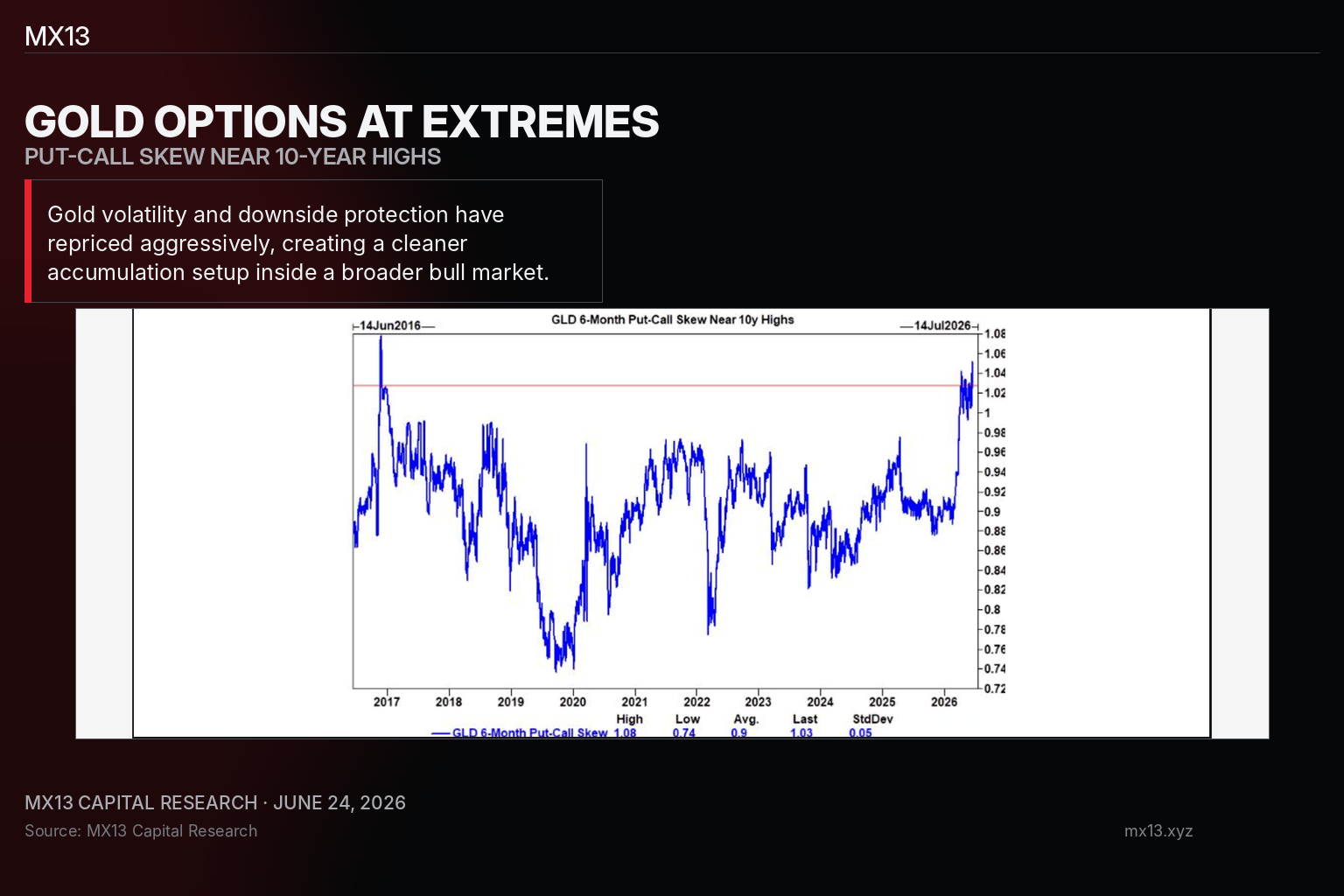
The second expression is gold accumulation. We remain bullish on gold over a 12+ month horizon and view the recent correction as an opportunity within a broader cyclical bull market. The January blowoff, the war-driven spike, and the sudden repricing toward a more hawkish rate path have created a sharp correction in a thesis we still believe remains intact. As laid out in our prior gold work, we are looking to accumulate gold below $4,000 and continue to view GDX as attractive in the mentioned range. We expect the summer may provide better opportunities to build exposure.
The third expression is high-growth equities. If the rates thesis is correct and the market moves away from pricing a renewed tightening cycle, the biggest equity beneficiaries should be the assets most sensitive to real rates, liquidity, and forward growth expectations. We are specifically focused on high-growth, high-short-interest stocks where fundamentals remain intact but positioning and sentiment have been pressured by hawkish policy expectations. If the curve reprices less hawkish, this bucket should have the potential for more convex upside.
Rates sit at the center of nearly every asset-pricing framework. When the curve is wrong, the resulting dislocations rarely stay contained to rates alone.