
This report is our attempt to underwrite the value we see in AST SpaceMobile (ASTS US) as it builds a cellular network that could carry internet coverage beyond the last ground tower. We will look at the competitive field, the hardware and carrier model, and what a mature customer base could be worth in today's dollars.
We start with Elon Musk's SpaceX, AST's most prominent rival, and its recent declaration that it wants to become a major U.S. mobile carrier. In our view, these are the two central players in direct-to-phone broadband, pursuing very different routes: SpaceX wants to own the mobile relationship; AST wants to supply the orbital network to carriers that already serve billions of customers.
Then we make the case for why connectivity everywhere is becoming an ordinary expectation. We show what AST's satellites have already done with ordinary phones, how its carrier partnerships and government work could turn that engineering into a business, and why founder Abel Avellan has committed so much to the outcome.
We finish with a 2030 valuation built from potential paying customers in the U.S. and abroad, AST's share of the monthly bill, margins, and the shares that could exist by then. We discount those future values back to today so the bet can be judged against the stock price now.
At MX13, our view is deliberately unfashionable: diversification is the greatest killer of returns. We strongly prefer to earn conviction through the work and size the rare opportunities where our estimate of value is far from the market's. AST is one of those investments. We own it in size, and we want to see this space race through.
The Field Is Set
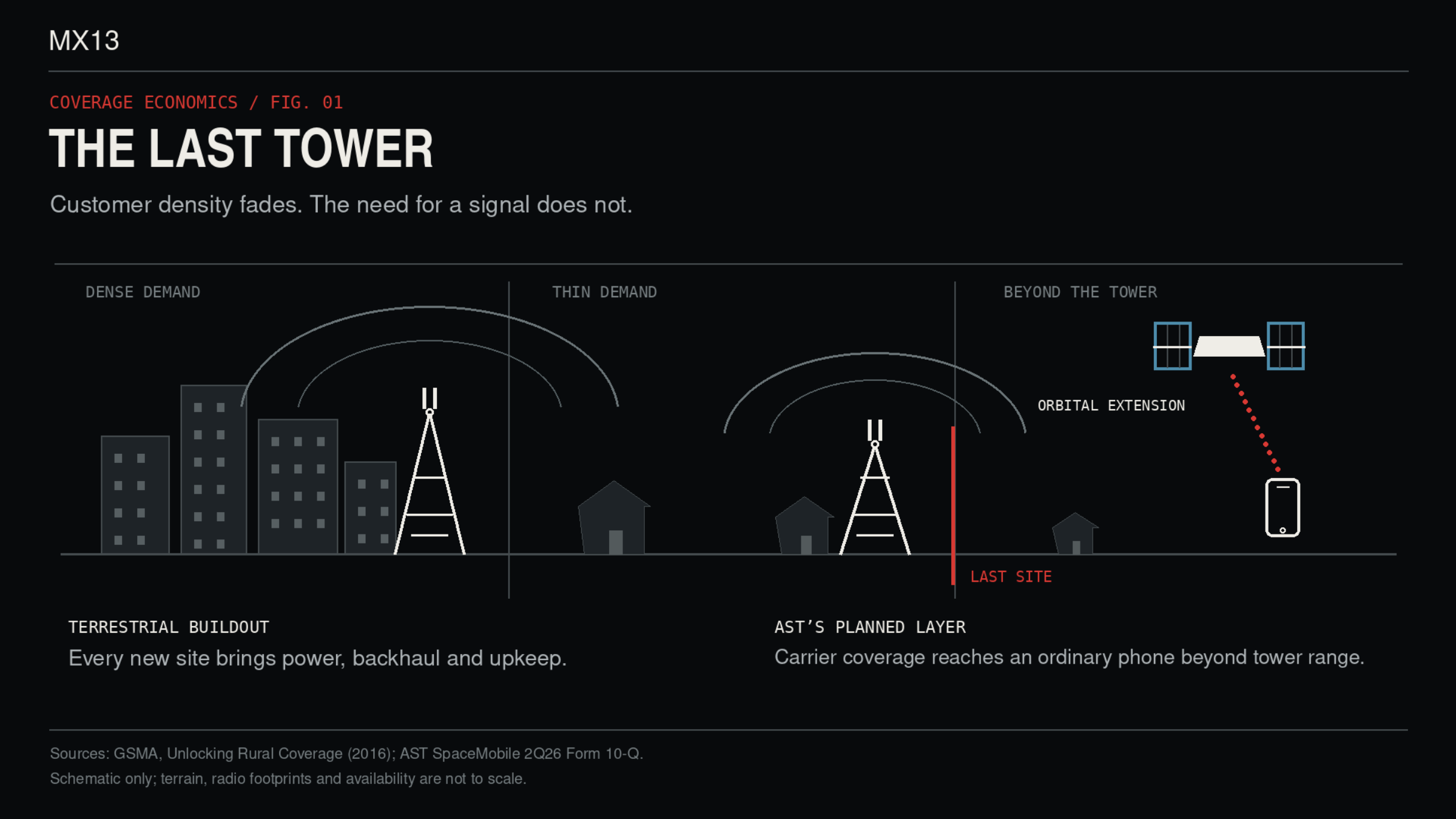
Your phone relies on nearby ground towers. Beyond the last tower, the plan you pay for can suddenly lose its connection. Direct-to-device, or D2D, fills that gap: a satellite connects to the phone you already own, without a dish or a special handset. Get it right and a carrier can extend service across roads, coastlines, and other places where towers do not reach. That is the market AST SpaceMobile and SpaceX are fighting over.
SpaceX is worth roughly $2.2 trillion. AST is worth roughly $20 billion. One is the market's chosen space empire; the other is building what we believe could become the orbital layer of the world's mobile networks. The difference in price makes the question unusually interesting: who has designed the better connection to an ordinary phone, and who can get it into the plans people already buy?
In the U.S., the carrier map starts with AT&T, Verizon, and T-Mobile. These are the three giants selling the phone plans, running the ground networks, and billing the customers. AST's proposal is to make their networks reach farther. It has definitive commercial agreements with AT&T and Verizon—two of the three. T-Mobile, meanwhile, built its current satellite offering around SpaceX. That was the field before SpaceX's latest announcement.
There was a new alignment before SpaceX spoke. On October 1st, all three carriers entered a joint venture to pool limited spectrum and make satellite service work more smoothly across their networks. Their existing satellite deals remain in place: AT&T and Verizon have AST agreements, and T-Mobile still sells a SpaceX-powered service. The venture is open to satellite providers, not an exclusive AST channel. But the carriers are clearly organizing to keep satellite coverage inside the mobile relationship they own. A week later, SpaceX said it wanted to be a major carrier itself.
Just after the market closed on October 8, SpaceX announced that it had agreed to buy nationwide low-band spectrum from Grain Management: licenses to use lower-frequency radio airwaves that travel farther and get through obstacles better. It adds to the spectrum SpaceX previously bought from EchoStar. And SpaceX did not leave its objective for investors to guess. In its own words, the deal would “pave the way for Starlink Mobile to become a major mobile carrier in the US.” Read that again. SpaceX wants to become a carrier itself. That is a declaration of war on the telecom majors.
T-Mobile still sells its Starlink-powered satellite service, and it has announced no AST deal. But SpaceX has blown up the strategic logic of their arrangement. T-Mobile enlisted a supplier to fill its dead zones; that supplier now says it wants to become a major carrier itself, combining satellites with terrestrial radio sites on the ground. The Grain purchase still needs regulatory approval, and building a rival carrier will take far more than buying spectrum. The intent, though, is no longer a theory we cooked up. SpaceX wrote it down.
We think T-Mobile will eventually want the same AST option its two largest rivals already have. Our call is that the Starlink alignment gives way to an AST relationship, putting all three U.S. giants on AST's side of the orbital network. An AST–T-Mobile agreement is the announcement to watch. It could come sooner than the market expects, even while T-Mobile continues its current service. That is our expectation, not an announced side switch. T-Mobile's technology chief offered a telling response to SpaceX's carrier ambition: “If this is truly the beginning of a new wireless provider in America, we welcome competition.”
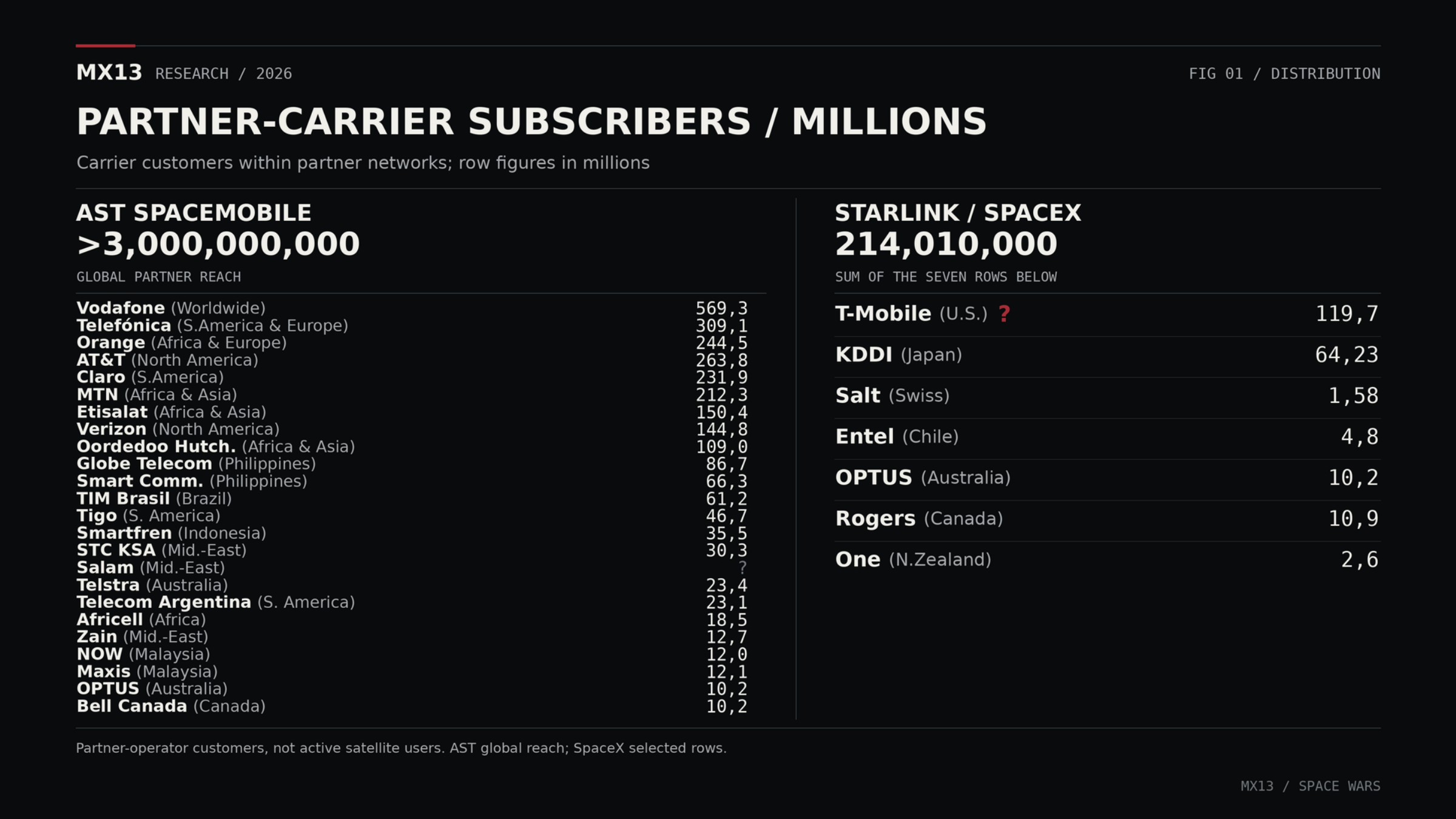
AST is making the opposite bet. It wants the mobile network operators, or MNOs, to keep the customer, the bill, the licensed airwaves, and the brand while AST supplies the orbital connection. The U.S. deals are the immediate battle, but this is not only a three-carrier story: AST reports more than 60 MNO partnerships whose carriers collectively serve over three billion subscribers around the world. Those are partner customers, not AST's paying users. Vodafone and AST have also formed a European venture to bring this model to other carriers. A satellite overhead is impressive engineering. A satellite plugged into the networks that already serve the world's phones is an industry.
And look at what the market is willing to pay for the rival. Last quarter, SpaceX's Starlink-led Connectivity business generated $4.29 billion of its $7.81 billion in total revenue—about 55% of the company. The segment includes consumer, enterprise, and government sales; SpaceX does not disclose a Starlink-only revenue line. At a roughly $2.2 trillion market value, the whole company trades at about 70x its latest quarter's annualized revenue.
What is that price buying? A bet that SpaceX will take on the U.S. telecom giants, despite AT&T and Verizon already having AST in their corner; a promise of AI data centers in orbit; and, naturally, the Elon premium. Apparently SpaceX gets paid today for every frontier it says it will conquer tomorrow. AST, valued at a fraction of that, is still being asked to prove its future one satellite at a time. That gap in expectations is the investment setup.
Both can win customers. Direct-to-device is a global market, not a single trophy to hand to whoever launches the most satellites. SpaceX arrives with a giant existing business and a $2.2 trillion price tag that already credits launch, AI, mobile, and the next Musk frontier. AST is a roughly $20 billion public-market pure play on space-based cellular broadband, built around carriers that already have the customers and a design that has demonstrated real phone calls and data. We are here to price that opportunity, not to demand that SpaceX fail. AST only needs to win a meaningful piece of a very large market for the investment math to become extraordinary.
Innovation Only Goes One Way
The market above can sound like a service for the occasional emergency. That misses how people use the internet now. Our phones handle payments, directions, work, and conversations; we notice the network only when it fails. Cars, wearables, sensors, and the next generation of devices add to that demand. The internet is woven too deeply into ordinary life for coverage to remain a patchwork of places where a tower happens to be profitable.
Direct-to-device is the next quiet upgrade. Most people will never know which spacecraft covers them. They will see satellite coverage folded into a premium plan or add it to the carrier bill they already pay. No new dish, no specialist phone, no second account. When the terrestrial network ends, the orbital layer can take over. They are not buying a rescue service for the occasional trip into the mountains. They are buying a better default for mobile internet. Soon a phone plan without that promise will feel incomplete. People already pay for better connectivity without calculating exactly how often they use every feature. A connection that follows them is an easy proposition to understand.
A ground tower needs land, power, a link back to the wider network, maintenance, and enough local customers to justify the expense. Those economics leave gaps that grow more conspicuous as the rest of life becomes connected. A satellite network changes the geometry: one shared orbital layer can reach across those gaps and serve many carriers. The demand extends beyond phones. More connected machines and services will need the same thing people do: a reliable link wherever they happen to be. The prize is a widening market for connectivity beyond the last tower, not a niche product for the rare emergency.
That is the space toll we see AST building. Its partners keep the customer and sell the plan; AST supplies the orbital reach and earns a wholesale share of the services they sell on it. As more carriers and devices need access beyond towers, a successful shared constellation can spread its cost across a much larger paying base. SpaceX will win some of this market too. We think AST has the better direct-to-phone architecture and the better path through the carriers. The shift toward expecting internet everywhere is already underway. Whether AST can collect that toll depends on the quality of the connection its hardware can deliver.
Superior Engineering
AST's technology moat starts with the phone itself. An ordinary handset has a small antenna and limited power. To get that weak signal to and from a spacecraft hundreds of miles above Earth, the satellite needs a powerful radio system. AST builds that system into each BlueBird. Its phased array is a broad, flat grid of antennas that can aim radio beams electronically, listen for the faint signal below, and focus a reply on a particular area. The goal is ordinary voice, video, and broadband data on the phone people already carry.
The hardware has grown in deliberate steps. BlueWalker 3, the prototype, unfolded a 693-square-foot array and demonstrated voice, video, and 5G calls. BlueBirds 1–5, the first commercial generation, kept that array size but increased processing bandwidth tenfold. They have demonstrated video and VoLTE—an ordinary cellular voice call carried through a partner's mobile network—and measured a 98.9 Mbps peak to an unmodified phone. Mbps measures how quickly data moves; that number is an observed peak in a test, not a promise that every customer will see it. The successful call through AT&T's network shows more than a phone briefly detecting a satellite: the connection made it back into the carrier system the customer already uses.
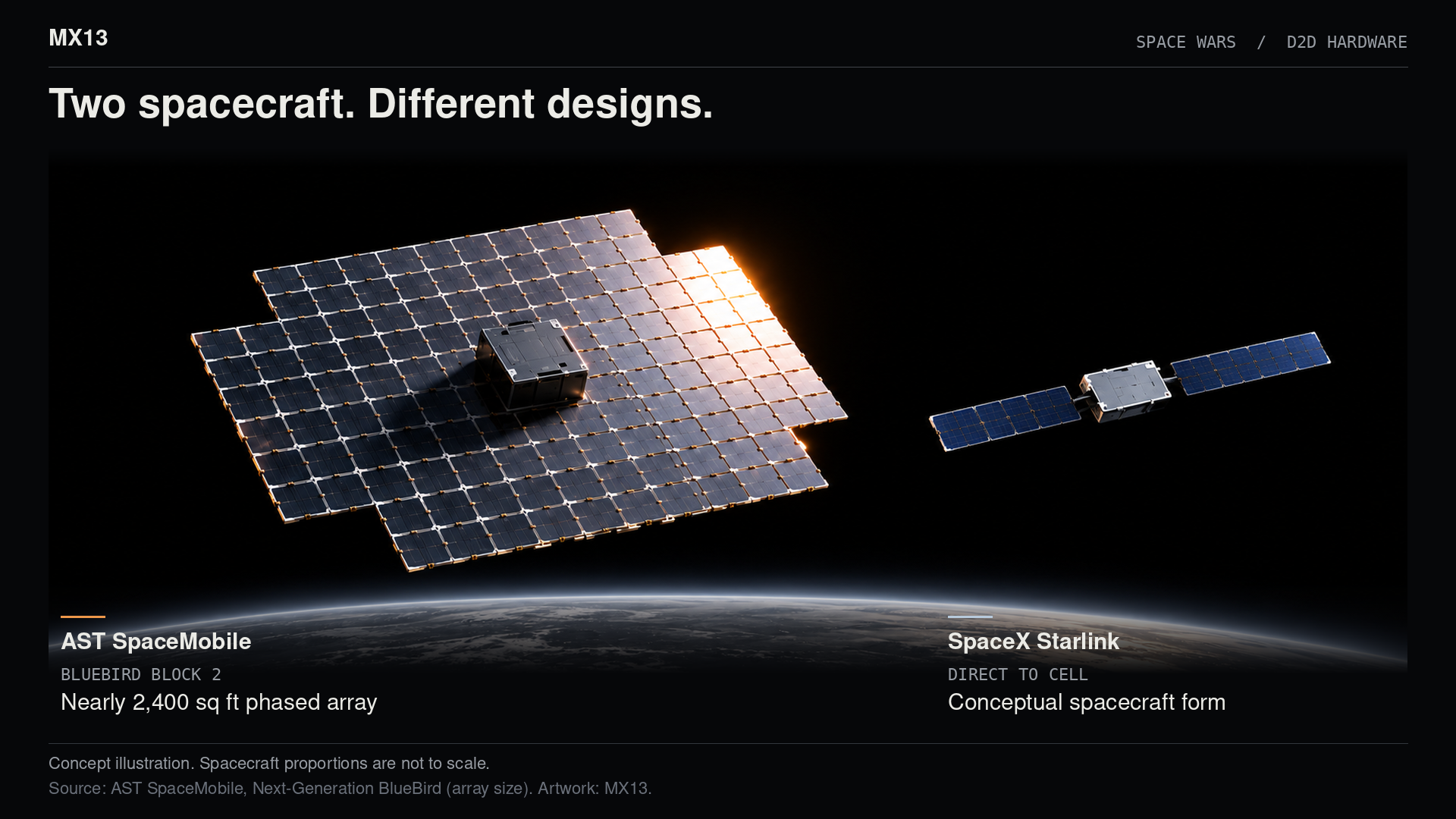
Block 2, the next-generation BlueBird design, takes the array to nearly 2,400 square feet, more than three times the area of the first generation. Its beams are designed to divide a large footprint into more than 2,000 coverage cells so the spacecraft can serve many areas at once. AST's custom AST5000 ASIC—a chip built specifically for this radio work—is designed to process up to 10 GHz of signal bandwidth per satellite. That is processing capacity, not a phone's download speed. AST targets peaks above 150 Mbps per coverage cell with this design. These are next-generation design targets; the 98.9 Mbps handset result belongs to the earlier BlueBirds. AST designs its commercial satellites for up to ten years of service, although that lifetime has yet to be proven across a mature fleet.
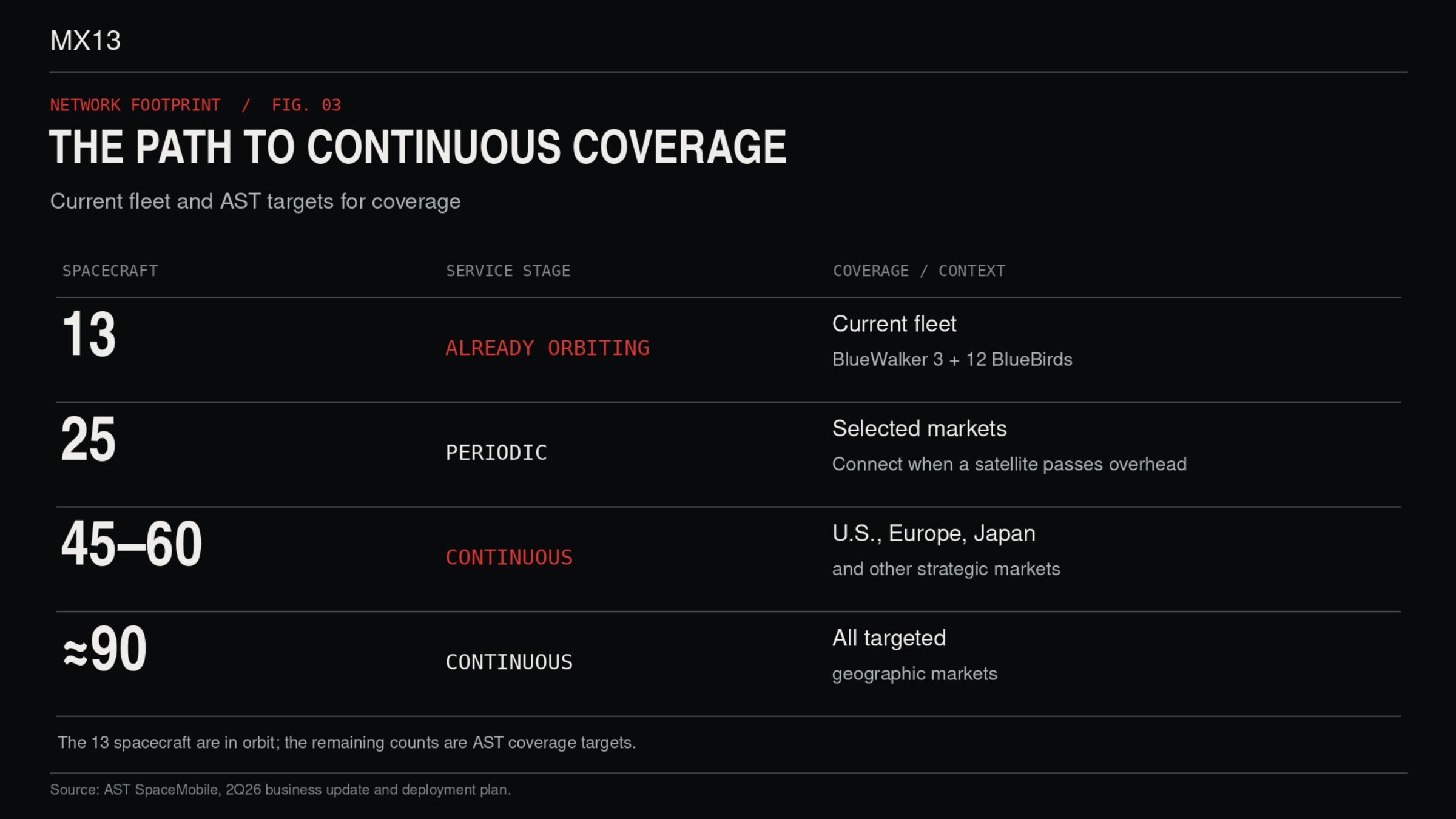
The hardware is already overhead. AST has 13 spacecraft in orbit: the BlueWalker 3 prototype, five first-generation BlueBirds, and seven Block 2 BlueBirds. Abel Avellan says all 13 are performing as planned. They were built and launched, and their combined arrays span about 20,000 square feet. This is a real orbital base, even though continuous service needs a much larger fleet.
The factory is filling that gap, with spacecraft at different stages of readiness:
- At the launch site: BlueBirds 14–16 have reached Cape Canaveral for launch.
- In integration: At its manufacturing base in Midland, Texas, AST says more than 20 spacecraft structures are being integrated, with builds underway through BlueBird 50. A structure being assembled is not a finished, tested satellite.
- Antenna panels: In its August filing, AST reported fully assembled modular antenna panels—called microns—for up to 36 BlueBirds, including those already shipped or launched.
The production work reaches far beyond the 13 in orbit, without pretending that 50 are ready to fly.
AST operates roughly 500,000 square feet of manufacturing and operations space globally, anchored by satellite assembly and testing in Midland, and has announced another 400,000-square-foot Midland expansion. It has installed capacity to assemble and test up to six Block 2 satellites a month and is ramping toward that output. If the line and the launch schedule begin to match, AST can turn the current fleet into a network at a pace the first years of the project could only hint at.
Size and speed are only part of the moat. AST designed the prototype to have a field of view above 300,000 square miles—the territory a satellite can see at a time, not a claim that it can give everyone in that area broadband at once. A spacecraft also moves across the sky, so a large footprint is not the same as a continuous connection. AST's plan calls for about 25 operating BlueBirds to provide periodic service in selected markets, 45–60 for continuous service in priority markets including the U.S., Europe, and Japan, and roughly 90 across its targeted geography. More simultaneous users and heavier video traffic would require capacity beyond those coverage milestones. The route from phone to satellite then runs through a ground gateway into the carrier's existing network, which handles the customer's service and bill.
Now compare the actual phone experience. SpaceX's first-generation Starlink Mobile system is operating, and T-Mobile customers can use messaging and selected satellite-ready apps, including WhatsApp voice and video chats. T-Mobile itself describes limits on speed and data-heavy use. That is a narrower commercial product than the general-purpose broadband AST is trying to build, while AST has already demonstrated a fast data link and native calls through carrier networks. SpaceX says its V2 satellites, custom chips, and new spectrum will produce a major jump in throughput and eventually full 5G mobile service. We take that ambition seriously. We also think AST's demonstrated broadband link and carrier integration deserve more credit than a rival's next-generation promise. SpaceX owns the rockets; AST's case rests on what the phone can do when the spacecraft is overhead.
The last piece of engineering is the handoff into the carrier's network. The satellite sends traffic through ground gateways, then into the carrier's existing mobile system. That is how the same phone number, plan, and bill can follow a customer past the last tower. AT&T's native call through its own network has already tested that path. AST says nearly 50 gateways are in different stages of construction, installation, and planning around the world. The carrier can sell the extra reach to the customer it already serves; AST can collect wholesale revenue without opening a retail phone company in every market. The signed agreements matter, but the next proof is a service the carriers market and people actually pay to use.
Military and Intelligence
The same connection sold through carriers has a second buyer: the U.S. military. Ground infrastructure can be knocked out, jammed, or simply absent. In those conditions, a satellite link to the handset already in someone's pocket is more than a coverage upgrade. AST and Fairwinds have demonstrated tactical voice, video, and data connections through BlueBird satellites using unmodified phones with participants from multiple branches of the armed forces. That is a field test, not an artist's rendering of a defense product.
A demonstration in Hawaii made the idea tangible. The team ran Tactical Assault Kit, the mapping and coordination software used by military units, over a secure satellite connection to ordinary smartphones. They streamed media and held a secure group video call. When a mission moves beyond cell towers, the familiar field toolkit can still work without setting up a specialized satellite terminal.
Government interest is showing up in contracts too. AST disclosed more than $125 million in aggregate U.S. government awards by its latest business update. Two of the pieces within that total:
- $43 million of expected revenue under an agreement through a prime contractor for tests using AST's first BlueBirds.
- $30 million fixed-price prototype contract awarded directly by the Space Development Agency to demonstrate tactical satellite communications on commercial spacecraft.
These contracts are included in the larger awards figure; they are not extra sums to add on top. AST also holds a prime position on the Missile Defense Agency's SHIELD contracting vehicle. The prototype is work won; SHIELD gives AST a chance to bid for more.
And military voice is only the first door. The broad, electronically steered array built to exchange signals with a phone can also be explored for radiolocation—using radio pulses to locate or track objects—and other kinds of sensing. AST says it is pursuing radar-related and other noncommunications applications. In September, the Space Development Agency supported AST's request to test pulsed radiolocation from BlueBirds. This is an experiment in turning the commercial satellite into an orbital sensor, with intelligence and defense uses far beyond a phone call. The government wants to find out what the hardware can see.
The customer map is widening too. Singapore's Defence Science and Technology Agency signed a contract to test AST's satellite cellular broadband for humanitarian assistance, disaster relief, and emergency response where ground coverage is unavailable. That is a different mission from a U.S. battlefield demonstration, and it makes the same point about resilience: governments do not need to build a separate satellite system for every place their people might have to work. AST offers a shared network designed to reach ordinary devices.
This is the part a consumer-only spreadsheet misses. One constellation can carry carrier traffic, provide a backup link for government users, and potentially support sensing applications. Government contracts can help finance and validate more spacecraft; more spacecraft improve the commercial service and give government buyers more reach. The prototype award and SHIELD position put AST in contention for longer-running programs, including work relevant to Golden Dome. A test turning into a program of record—an enduring funded procurement—would be an entirely different scale of business. The first awards are already proof that defense is more than a slide at the back of the deck.
Founder Profile
Abel Avellan is all in. Building the network described above takes someone willing to solve the spacecraft, chip, spectrum, and carrier problems together. Avellan had already built Emerging Markets Communications to connect ships and other hard-to-reach customers; he sold it for $550 million in 2016. He knew satellite coverage was possible, and that specialized terminals kept it from the ordinary person carrying an ordinary phone. Falling launch costs and advances in satellite hardware made a more ambitious answer possible. AST, founded the following year, would make the satellite meet the phone, with the carrier still owning the customer.
That ambition takes more than putting an antenna in orbit. AST had to make enormous phased arrays hear a weak handset signal, build chips and spacecraft, secure access to licensed airwaves, and persuade mobile operators to put their brands behind a network that had never existed. Avellan brought an electrical engineer's grasp of the problem and decades of satellite experience to that campaign; he is a co-inventor of 21 U.S. patents. The carrier coalition did not appear because the pitch deck looked good. He assembled it while the engineering was still being proven.
The company has been built around that conviction. AST owns and expands its spacecraft production facilities rather than treating the satellite as a specification handed to someone else. It has to coordinate antenna design, chip production, launch slots, spectrum arrangements, ground gateways, and carrier testing so they converge into one service. Coordinating those pieces is its own feat of company-building, as demanding as the engineering. The founder's willingness to keep control of the whole problem is one reason we believe this network has made it from improbable idea to working hardware and major-carrier agreements.
His incentives remain tied heavily to the outcome: Avellan owns about 21% of AST on a common-equivalent basis. He has drawn no base salary since the 2021 public listing and received no cash bonus for 2025. His compensation includes equity awards with both time- and performance-based conditions. A prepaid forward against part of his stake gave him liquidity in 2026, but left roughly a fifth of the company riding on what he builds next. He spent years recruiting the people and carriers needed to turn an improbable idea into working hardware. His judgment is inseparable from this investment. We like having that builder at the center of it.
Valuation
“We think the -10% move on Friday was misguided.” Deutsche Bank said that on Monday, October 12, as it upgraded AST from Hold to Buy and kept its $93 price target. We couldn't have said it better ourselves. Following SpaceX's carrier announcement, AST lost 10.5% on October 9 as roughly 54 million shares changed hands. It touched $47.57 and closed at $50.97. A stock that traded above $130 in May was back near a $20 billion equity value. The market sold AST as if SpaceX's new spectrum made the carrier-backed network less valuable. We see SpaceX moving into direct competition with the very carriers AST is built to serve.
Deutsche Bank estimates AST's enterprise value at $23 billion and assigns $19 billion to its long-term Ligado spectrum rights using the price per MHz-pop in SpaceX's EchoStar deal as a benchmark. On that comparison, only $4 billion of EV, or about $10 per share, remains for the satellites, chips, manufacturing, patents, carrier integrations, and government work. Those rights are contractual leases, and $19 billion is an analyst's appraisal, not a liquidation value or cash sitting on AST's balance sheet. We also refuse to add that appraisal on top of an earnings multiple later in this section: the network needs those airwaves to produce the earnings. Even allowing for those distinctions, this is a remarkable price for the company that has built the carrier route into D2D broadband.
So what does it take to finish that route? At June 30, AST reported $2.29 billion of unrestricted cash, $435 million of restricted cash, and $3.02 billion of gross debt. The July convertible offering added $1.13 billion of net proceeds; AST spent $111 million of that on a capped call designed to limit dilution from those new notes. On a simple pro forma basis, that leaves roughly $3.31 billion of unrestricted cash, $4.17 billion of gross debt, and $0.86 billion of net debt if restricted cash is excluded. This is a financed buildout with real assets and real obligations, not a spreadsheet in which the satellite fleet appears for free.
The spending is visible, too. In the first half of 2026, operations used $145 million of cash and purchases of property and equipment used $859 million. The company has invested heavily in satellites, launch, manufacturing, and ground infrastructure ahead of widespread service revenue. Management estimates $21–23 million of direct material and launch cost per Block 2 satellite on average across a fleet of more than 90, with early units costing more and future efficiencies assumed. It says the manufacture and launch of approximately 90 satellites is funded. That statement covers a defined constellation program; higher capacity, replacement satellites, gateways, spectrum payments, and later expansion still have to be financed by operations, partners, or capital markets. The beauty of the space toll is the recurring revenue after the hard part is built. The expense of reaching that point belongs in the thesis.
And every share has a claim on that toll. At June 30, AST had 299.7 million Class A shares plus 89.4 million exchangeable Class B and C economic interests—about 389.1 million common equivalents before future dilution. The filing also lists 12.2 million potential shares from equity awards and 25.8 million from outstanding convertibles; July's notes could add another 14.5 million at the initial conversion rate. The July capped call is designed to offset dilution between its approximately $79.57 conversion price and $149.20 cap, but it does not eliminate every possible future issuance. We therefore model 480 million economic shares in the 2030 base case, 550 million in the bear case, and 500 million in the bull case, allowing room for stock compensation, financing, and capacity expansion. Those are our underwriting inputs, not company guidance. If a note converts into shares, its principal cannot also remain in the debt deduction; each case's future net debt and share count must describe one consistent capital structure.
Now for the income those shares could own. T-Mobile sells its current satellite add-on for $10 a month, which gives us a real retail price anchor. The frequently cited 80/20 SpaceX split is a conditional term in a separate, prospective EchoStar/Boost–SpaceX broadband agreement. It does not establish that Starlink collects $8 of each T-Mobile subscriber's $10. An older AST–Vodafone agreement contemplated 50/50 sharing in specified markets; the terms of future U.S. and global carrier deals are not universally disclosed. We use a modeled $10 retail add-on and vary AST's revenue take in the scenarios below. These are choices in our model, not reported contract economics.
We use approximately 395 million U.S. mobile voice subscriptions as the domestic pool. For the wider opportunity, GSMA projects 5.5 billion mobile-internet users worldwide in 2030; after carving out roughly 400 million for the U.S., we round the rest of the world to 5.1 billion. One source counts lines and the other counts unique people, so these are deliberately approximate opportunity pools. They are also larger than the more than three billion subscribers reached by AST's current MNO partners. The international case requires additional carrier coverage, sales and network capacity, not just the agreements already signed.
Here is what each 2030 consumer-service case asks of the network:
- Bear: 5% of U.S. lines pay AST $2.50 a month (25% of modeled retail); 1% of the rest-of-world pool pays AST $2. That is $1.82 billion of annual revenue and, at a 40% EBITDA margin, $0.73 billion of consumer EBITDA.
- Base: 10% of U.S. lines—39.5 million subscribers—pay AST $5 a month (50%), generating $2.37 billion annually. Another 5% abroad—255 million subscribers—pay AST $3 (30%), generating $9.18 billion. Together: $11.55 billion in recurring revenue and, at a 70% margin, $8.09 billion of consumer EBITDA.
- Bull: 20% of U.S. lines pay AST $7.50 a month (75%); 10% abroad pay AST $4. That is $31.59 billion of annual revenue and, at an 80% margin, $25.27 billion of consumer EBITDA.
All three keep the $10 retail price as a common yardstick, including internationally; actual local prices and bundling will vary. At maturity, a wholesale network with the carriers handling the customer relationship can have extraordinary economics. Our base assumes substantial operating leverage even after paying to run and expand a much larger fleet. These are margins we expect the network could reach at scale, not margins it earns today.
There are two more ways AST can collect from the same orbital infrastructure. In emergency services, start with an illustrative 12 million eligible FirstNet and Verizon Frontline lines; a modeled 50% attachment at $10 a month to AST would be $720 million of U.S. annual revenue before costs. Our additional-business sensitivity carries $650 million of U.S. emergency-services EBITDA and $360 million internationally, plus $675 million of U.S. defense EBITDA and $450 million internationally. That is $2.135 billion of potential annual EBITDA across emergency and defense. The first-responder margin implicit in those figures is high, and defense procurement is lumpy. These are prospective normalized earnings, not awarded contract value or revenue AST recognizes today. We show their contribution separately so the consumer case can stand on its own; any overlapping consumer and enterprise fees must be removed as contracts become visible.
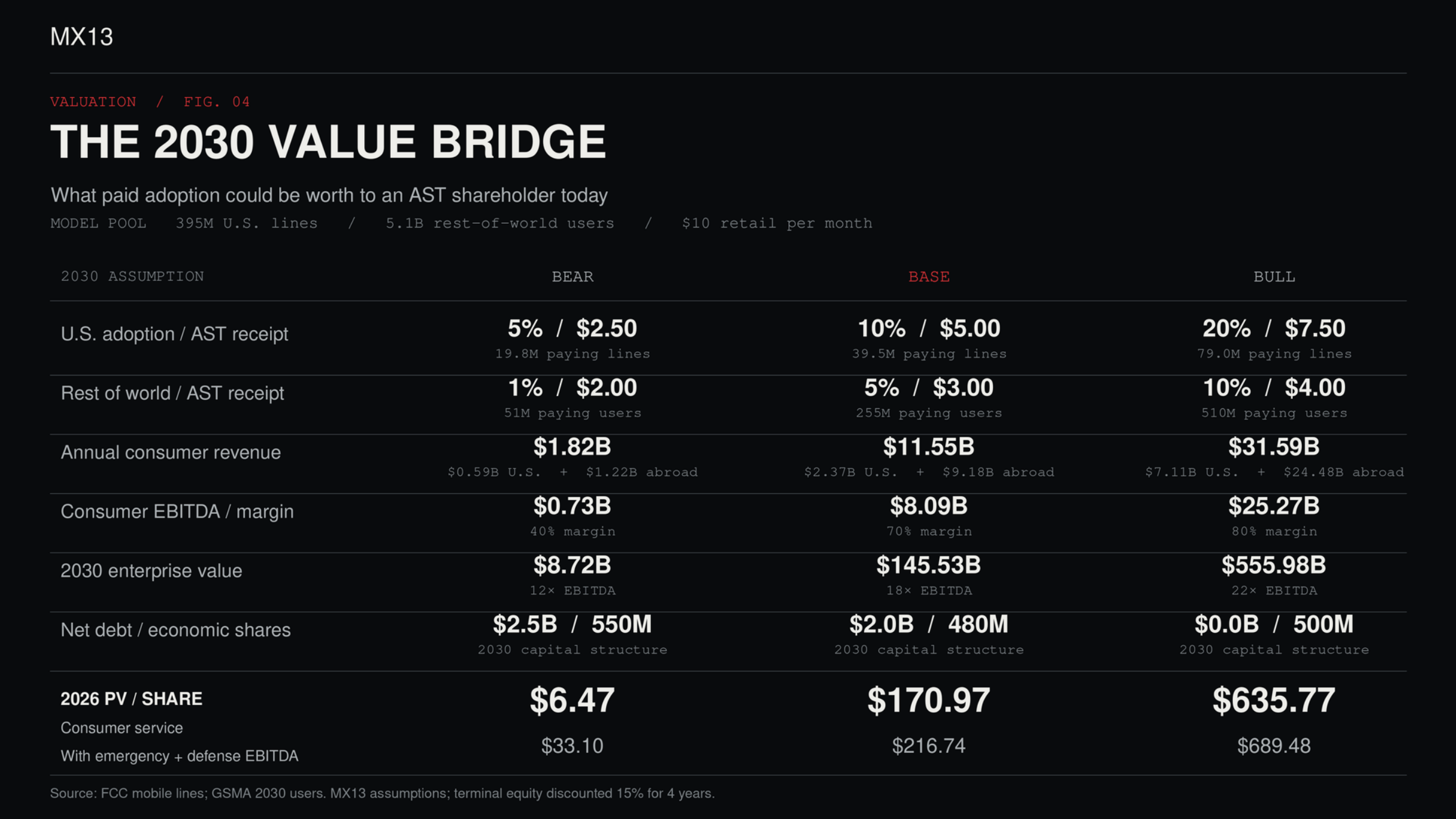
Here is the full bridge back to a share bought today. Apply 12×, 18×, and 22× 2030 EBITDA to the bear, base, and bull consumer cases; deduct $2.5 billion, $2.0 billion, and zero of assumed 2030 net debt, respectively; then discount the resulting 2030 equity value four years at 15% a year and divide by the future economic shares above. The discount factor is 1.749. The consumer-only present values are about $6.47, $170.97, and $635.77 per share. If the entire separately modeled $2.135 billion of emergency and defense EBITDA materializes, those values rise to $33.10, $216.74, and $689.48. In the base case, for example, $8.085 billion of consumer EBITDA at 18× yields $145.53 billion of 2030 EV. Less $2 billion of net debt, discounted four years and spread over 480 million shares, that is $170.97 today; the other businesses add about $45.78 per share if earned at the same multiple.
These are 2030 terminal-value scenarios, not a promise that the shares trade at those prices next quarter or a detailed forecast of each intervening year's free cash flow. We have not counted interim distributions, and future spending is represented only through the terminal debt and dilution assumptions. The range is wide because the question is enormous: can AST turn carrier reach into an everyday paid feature while expanding capacity fast enough to serve it? Even our base takes only a fraction of the global mobile-internet pool, yet it asks AST to serve nearly 295 million paying accounts. That will take a network beyond the initial coverage fleet. We are buying a long buildout, testing, rollout, and revenue ramp through 2030. At roughly $50 a share, the market is giving us a chance to underwrite that future while the towers are still being put in orbit.
What We're Watching
The valuation above depends on carrier distribution turning into paid service. AT&T, Verizon, Vodafone, and global partners have to do more than sign agreements: they must integrate, market, and sell coverage customers choose to use. If the biggest MNOs decide to go it alone, give the prime position to a competitor, or leave satellite coverage buried in a plan nobody notices, the beautiful wholesale flywheel never spins. We need carrier customers in multiple countries, not just logos spanning multiple countries.
The launch calendar is the other critical watch item. In March, management targeted 45–60 satellites in orbit by the end of 2026; by August, the filing pointed to roughly 45 in early 2027. That is a missed timetable, and we want better guidance from here. AST lost BlueBird 7 when a Blue Origin rocket left it too low to stay in orbit, and damage to Blue Origin's launch pad further squeezed near-term capacity. SpaceX has successfully carried AST's large satellite batches, but it is also building a competing mobile network. AST has agreements with multiple launch providers; getting frequent, dependable slots still depends on rockets and schedules it does not control.
We expect launches to accelerate materially in 2027 as satellites now moving through the factory reach flight readiness and launch capacity improves. That is our expectation, not a calendar already secured. A spacecraft still has to be launched, unfolded, tested, and put into service before it improves the product a carrier can sell. More delays would push back continuous coverage and paying subscribers while the network keeps spending. The proof we want is a sustained launch rhythm and operating satellites in orbit, backed by management guidance that earns trust again.
Building the network also takes money. AST projects an average $21–23 million in direct materials and launch costs for each satellite in a fleet of more than 90 Block 2 BlueBirds; early units cost more. After its July financing, management said the planned manufacture-and-launch program was funded. That addresses the initial coverage fleet, not every later capacity upgrade or replacement satellite. A network can be right about the destination and still ask shareholders to pay too much for the trip.
The network must then deliver what those carriers sell. AST needs frequent launches, working Block 2 arrays and chips, permission to use the necessary airwaves, working ground gateways, and enough capacity that a compelling broadband promise survives real customer demand. SpaceX could improve its own D2D hardware and close the gap. These are the pressure points we will watch. They are also why each native call, each deployment, each signed carrier integration, and eventually each paying subscriber matters so much to us.