
This report presents our view that gold and Bitcoin are moving through different stages of the same hard-asset regime. Gold has already begun repricing the deterioration in fiscal flexibility, monetary credibility, and the quality of sovereign liabilities. Bitcoin has spent several months accumulating inside a broad $50,000 to $70,000 range and is now approaching the end of an unusually compressed volatility regime.
Markets remain focused on when the Federal Reserve will formally pivot. The more important adjustment may already be occurring through Treasury issuance, Federal Reserve bill purchases, reserve management, and the behavior of the long end of the curve. Recent changes in the Quarterly Refunding Announcement suggest that policymakers are creating more room to finance deficits through shorter-duration debt while maintaining sufficient liquidity across the banking and money-market systems. Gold has been pricing that policy direction. Bitcoin should become the higher-beta beneficiary once the same forces translate into broader liquidity support.
The path is not without risk. Persistent inflation could force the Federal Reserve to move beyond hawkish communication and deliver actual rate hikes. War could transmit through oil into higher inflation, real yields, and dollar strength. A disorderly yen carry-trade unwind could produce indiscriminate selling across every liquid asset. These outcomes would extend the accumulation period, but they would not automatically erase the structural case for owning scarce monetary assets.
Gold Has Been Smelling It Out
Our April report, The Gold Case, argued that gold’s decline represented a positioning and liquidity reset inside a structural monetary bull market. The market had moved too far and too quickly, leverage had accumulated around a consensus trade, and geopolitical stress forced investors to sell a profitable and liquid asset to raise cash. The correction removed a tactical premium while leaving the longer-duration drivers intact: fiscal expansion, sovereign debt accumulation, central-bank diversification, currency debasement, constrained mine supply, and persistent physical demand.
The thesis has since faced a more difficult policy environment than we expected. The Federal Reserve has remained hawkish, real rates have stayed elevated, long-duration bonds have weakened, and the dollar has periodically strengthened. Those conditions would normally weigh heavily on a non-yielding monetary asset. Gold instead held its broader structure and eventually accelerated, suggesting that the market is no longer trading it solely as an inverse expression of real yields.
A higher Treasury yield can reflect two very different environments. It can signal stronger real growth, credible disinflation, and an increasingly attractive return on government debt. It can also reflect excessive duration supply, persistent fiscal deficits, inflation uncertainty, and declining confidence in the government’s financing path. Gold tends to struggle in the first environment and strengthen in the second. The level of the yield alone does not identify which regime is being priced.
The 30-year bond increasingly appears to be carrying the adjustment that the policy rate has not delivered. Inflation has moderated at the margin, oil has retraced portions of its geopolitical advance, and parts of the growth data have softened, yet long-duration bonds have struggled to recover. The market may be demanding a larger term premium for fiscal uncertainty and the risk that future policy will tolerate more inflation than current rhetoric suggests.
Kevin Warsh appears comfortable allowing the long end to restore more market signal. A comparatively restrained short-rate path can coexist with higher 30-year yields because the market is free to price future inflation, debt supply, and fiscal credibility on its own. That steepening tightens financial conditions through mortgage rates, corporate financing costs, and equity valuations without requiring the Federal Reserve to deliver every adjustment through the overnight rate.
Gold holding firm while long-duration bonds fall would be one of the strongest confirmations of the thesis. The market would no longer be treating higher yields as a durable increase in the attractiveness of sovereign claims. It would be buying gold as protection against the reason those yields are rising.
The QRA Is the Policy Tell
The policy shift is easiest to see in the Treasury’s Quarterly Refunding Announcement. The QRA explains how the government expects to finance its borrowing needs over the coming quarter. Deficits determine how much debt must be issued, but Treasury still chooses the maturity of that debt. It can issue short-term bills that mature within months, or it can lock in financing through two-year, five-year, ten-year, and thirty-year coupon securities.
That choice resembles a borrower deciding between a short-term adjustable loan and a thirty-year fixed mortgage. Short-term funding may be cheaper today, but the borrower must refinance repeatedly. Long-term funding provides certainty, but it locks in the current rate for decades. Treasury is making that decision across trillions of dollars of government liabilities.
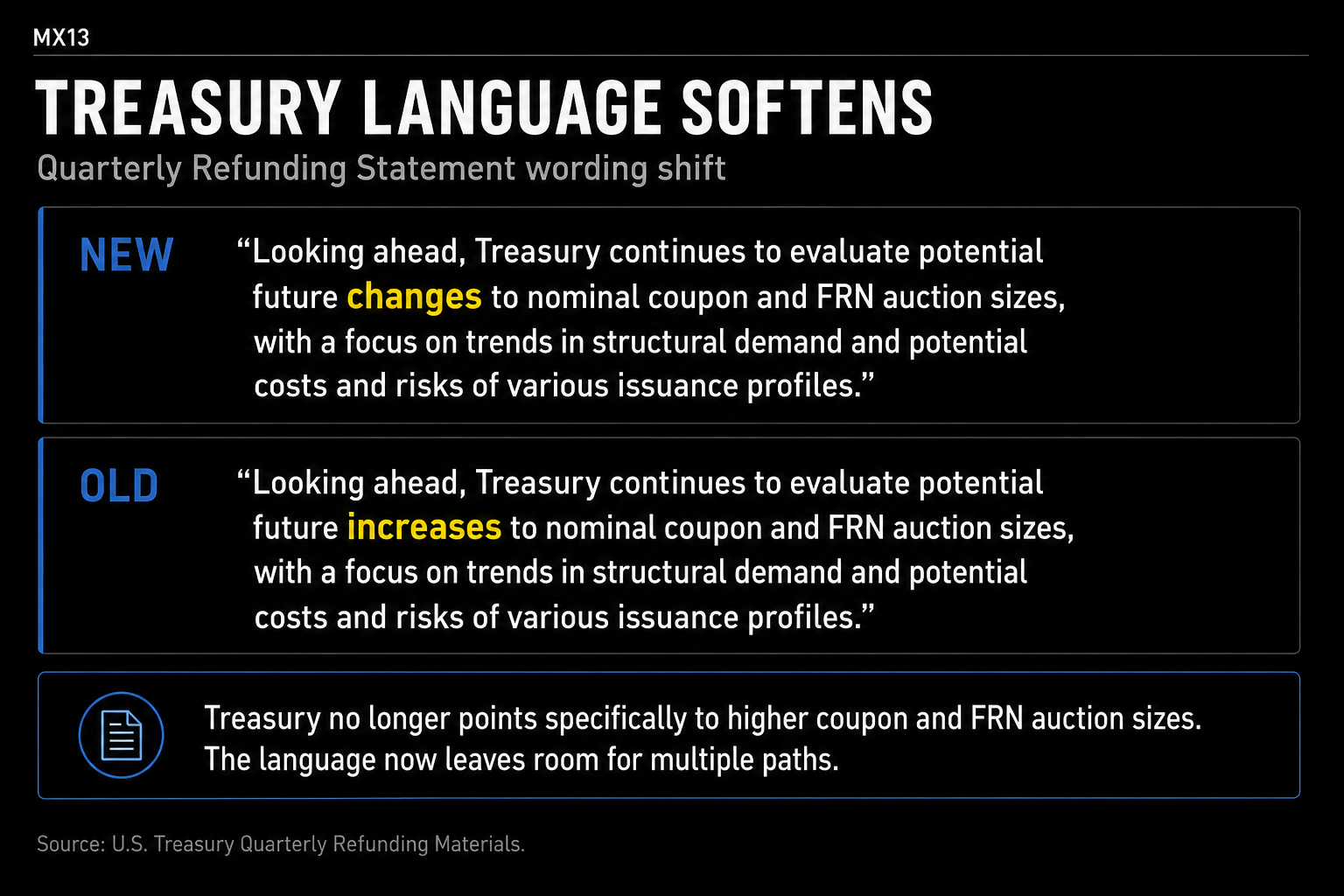
Earlier QRA language prepared the market for future “increases” in nominal coupon issuance. The latest wording changed that commitment to future “changes.” Treasury still expects to maintain current coupon sizes over the near term, but the guidance is no longer one-directional. Coupon reductions are formally back inside the available policy set.
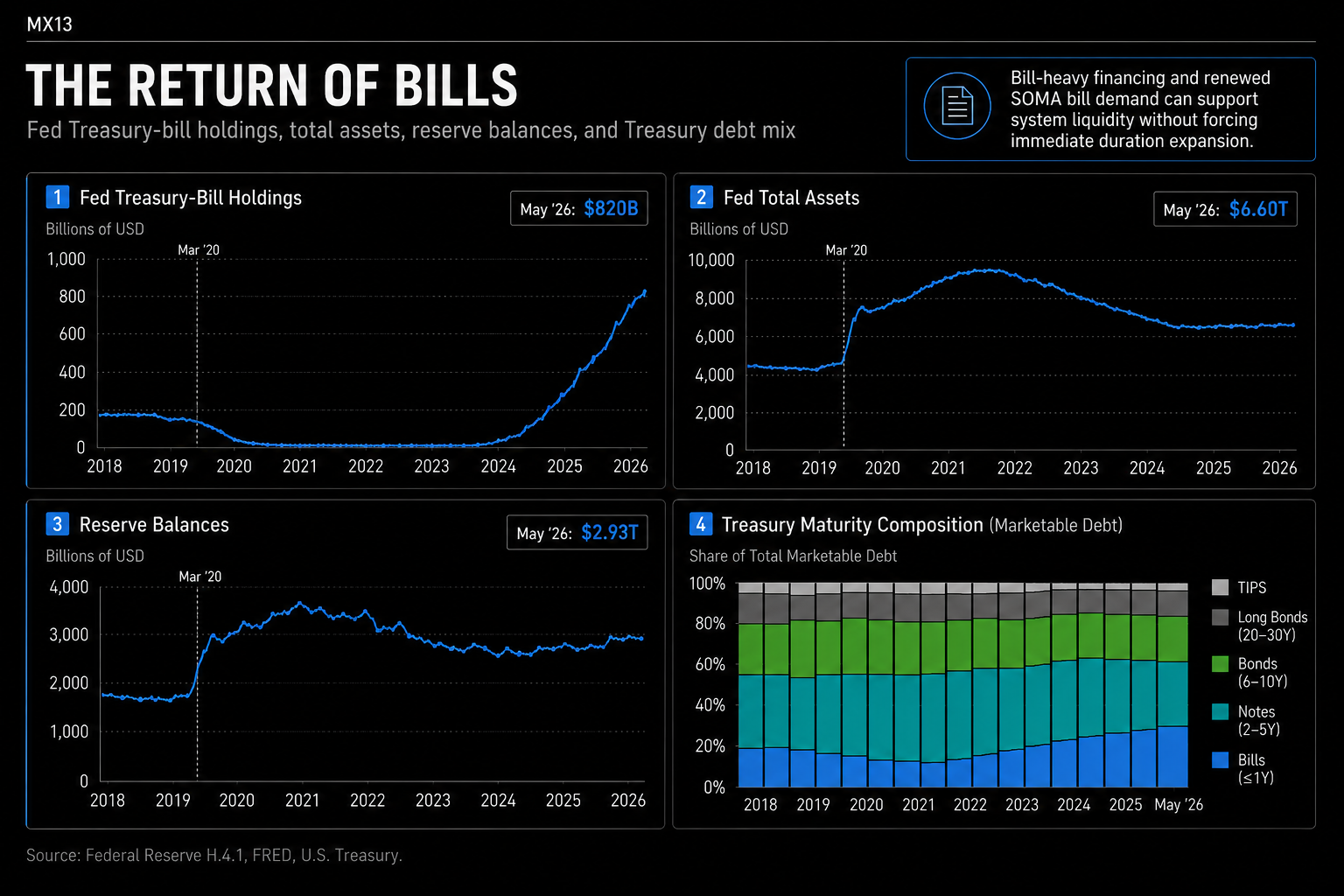
The surrounding language gives the change more weight. Treasury specifically pointed toward Federal Reserve purchases of Treasury bills and growing private demand for short-duration government paper. Money-market funds, banks, corporations, reserve managers, and the Federal Reserve are all natural buyers of bills. Treasury can lean more heavily on that pool of demand rather than forcing every additional dollar of borrowing through the long end.
The mechanism begins with the deficit. Large deficits require persistent debt issuance. Issuing more ten-year and thirty-year securities increases the amount of duration private investors must absorb. If investors are already concerned about inflation or fiscal risk, they demand higher yields before taking that supply. Those higher yields raise the government’s financing cost and tighten conditions across mortgages, corporate credit, equities, and the broader economy.
Strong bill demand gives Treasury another route. It can issue more short-duration debt where buyers are plentiful and reduce the need for an aggressive increase in long-term coupon supply. Less incremental duration entering the market removes one source of pressure from the long end, while a steep yield curve can make short-term financing cheaper than locking in current long-term rates.
Federal Reserve bill purchases support the same structure. When the Fed buys bills, it removes part of that supply from private circulation and credits reserves into the banking system. More reserves reduce the probability of funding stress across repo and money markets, while the Fed becomes a large buyer of the securities Treasury can issue most easily. The policy may be described as reserve management rather than quantitative easing, but the balance-sheet transmission still moves in an accommodative direction.
The full sequence runs from deficit spending into Treasury issuance, from Treasury issuance into the maturity mix, and from the maturity mix into market liquidity. Strong demand for bills allows the government to shorten its funding. Federal Reserve purchases absorb part of the bill supply and add reserves to the banking system. Private investors face less additional duration than they otherwise would, near-term financing costs remain more manageable, and the government can continue running large deficits without immediately overwhelming the long end.
The cost is greater rollover dependence. A government financed through shorter maturities must return to the market more frequently. It becomes more reliant on stable bill demand, ample reserves, functioning repo markets, and a central bank willing to prevent a funding accident. The government saves money today by accepting a deeper dependence on tomorrow’s liquidity conditions.
That is financial repression without an explicit yield cap. Treasury shortens issuance, the Federal Reserve maintains ample reserves, and private balance sheets are encouraged to absorb government paper. Each policy can be presented as a technical adjustment, yet the combined effect is to make a growing stock of sovereign liabilities easier to finance.
Gold benefits because the nominal supply of government claims continues rising while the policy system is being redesigned to sustain that expansion. Gold cannot be issued alongside those liabilities, carries no sovereign credit exposure, and does not depend on the refinancing capacity of the government. The market does not need to expect a currency collapse. A gradual realization that policymakers will prioritize financing stability over the long-run purchasing power of nominal claims is sufficient.
Bitcoin receives the same tailwind through a less direct channel. A Treasury bill purchase does not mechanically flow into Bitcoin. The relevant effect is the reduction in reserve scarcity and the lower probability of a prolonged dollar-liquidity shortage. The easier it becomes to preserve nominal growth and market functioning, the more likely the eventual policy distribution shifts toward accommodation rather than sustained deflation.
The unresolved tension remains at the long end. Treasury can alter the maturity of issuance, but it cannot remove the deficits or force private investors to ignore fiscal and inflation risk. The 30-year bond can continue selling even while bill markets remain well supported. That combination would allow Warsh to maintain hawkish language, leave the overnight rate relatively stable, and let longer-term yields perform more of the tightening.
Jackson Hole is the next major communication checkpoint. We will be watching for language around the balance sheet, reserve management, Treasury-market functioning, forward guidance, and the role of the long end in transmitting policy. A meaningful pivot may not arrive as a promise to cut rates. It may arrive as confirmation that the Federal Reserve intends to remain hawkish on inflation while retaining broad flexibility over the tools used to preserve liquidity.
Bitcoin Has Been Accumulating
Bitcoin is not entering an accumulation period. It has already spent months building one.
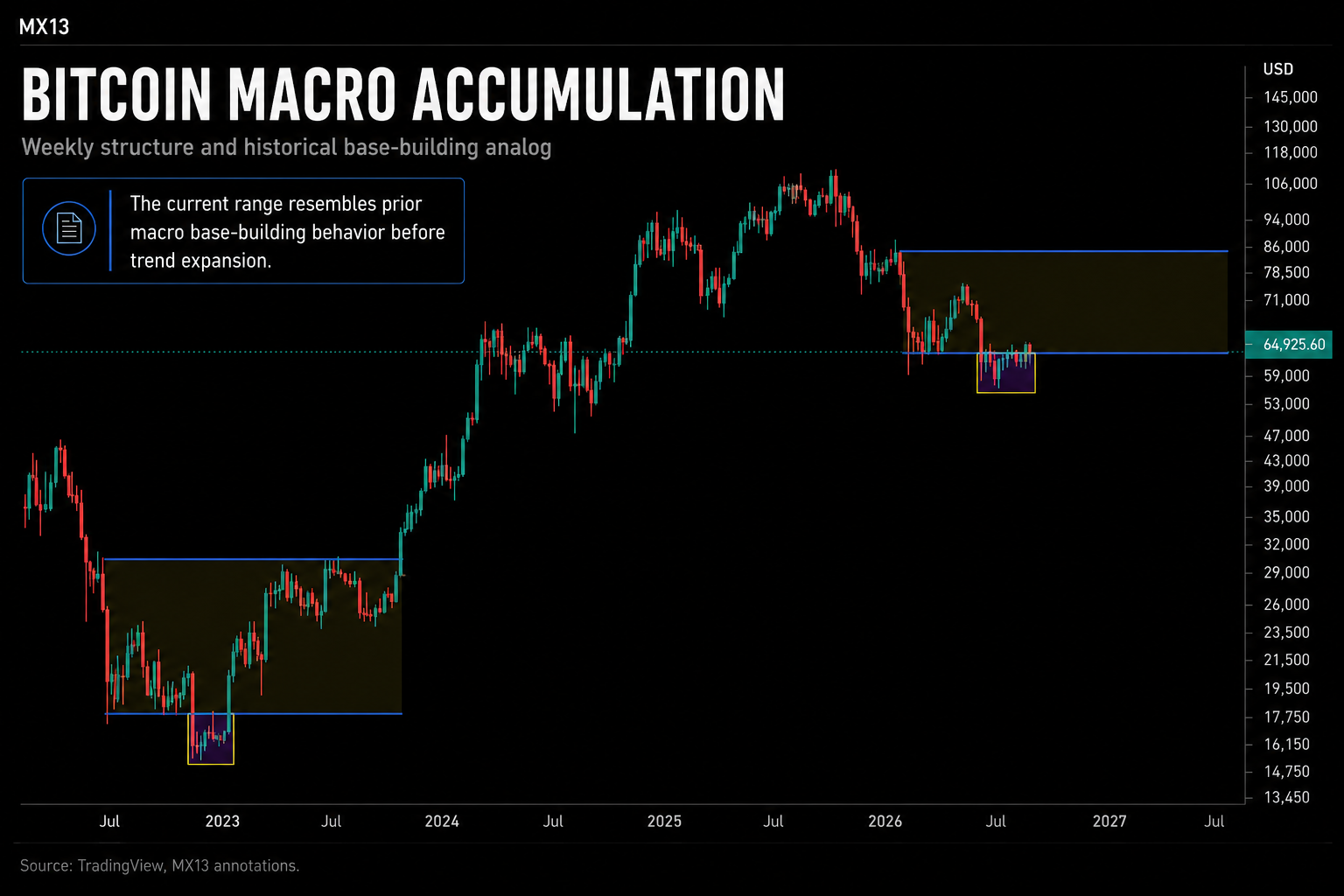
The $50,000 to $70,000 region has operated as a broad transfer zone in which crypto-specific stress has been absorbed without producing a durable structural breakdown. The market has digested the digital-asset treasury washout, concerns surrounding leveraged corporate balance sheets, weak sentiment, forced selling, and repeated failures to sustain upside momentum. Time has allowed trapped holders to exit, leverage to reset, and ownership to move toward participants with a longer horizon.
Volatility is now compressed to an extreme. Weekly at-the-money implied volatility near 29% to 30% sits in the bottom percentile of the annual distribution, while realized volatility has fallen to the lowest level in the available series. The last month has produced increasingly narrow price action despite a macro environment filled with rates uncertainty, geopolitical risk, equity volatility, and repeated policy intervention.
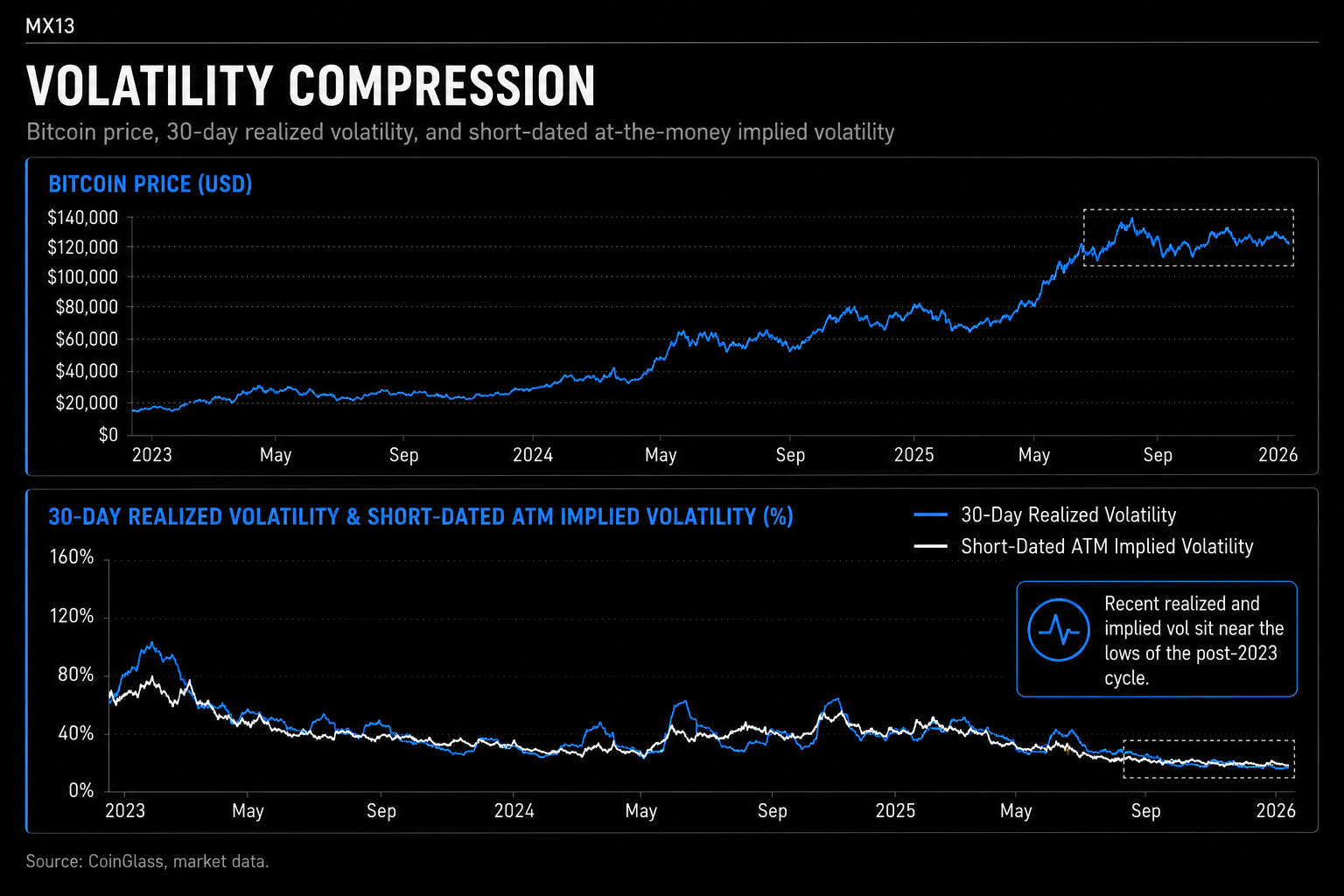
Compression does not determine direction. Low volatility can resolve through either side of the range. The surrounding conditions shape our bullish bias. Bitcoin has spent months absorbing negative information, crypto-specific leverage has been reduced, and the asset has begun showing periods of resilience against weaker equity markets. Policymakers have also demonstrated a willingness to support financial conditions before a severe market or economic breakdown occurs.
The setup fits the traditional sequencing of Bitcoin’s market cycles, even if the popular four-year-cycle framework has become less mechanical. Exchange-traded funds, institutional ownership, derivatives, corporate treasuries, and larger pools of global capital have changed the market’s structure. Bitcoin is not required to repeat the exact timing or amplitude of previous cycles.
The recurring pattern remains useful: expansion attracts leverage, leverage creates fragility, liquidation clears the excess, and a long period of price and time-based digestion transfers ownership before the next advance. The current range resembles the later portion of that process. Price has already experienced the drawdown, the narrative has deteriorated, sellers have been given months to exit, and volatility has nearly disappeared.
We continue to view $50,000 to $70,000 as an accumulation range rather than an area from which to abandon the asset. Sustained acceptance above $70,000 would materially increase the probability that the cyclical bottom is complete. Acceptance requires more than an intraday breach. Bitcoin would need to hold above the range, absorb profit-taking, and defend the level on subsequent tests.
A confirmed move above $70,000 would indicate that the supply accumulated throughout the range is no longer sufficient to contain price. It would not make Bitcoin immune to macro risk. The cyclical bottom can be complete internally while an exogenous shock, dollar-liquidity contraction, delivered hiking cycle, or global deleveraging event forces another decline. Barring that type of event, acceptance above the range would point toward a transition from accumulation into expansion.
Gold and Bitcoin occupy different positions in the same regime. Gold is already responding to Treasury financing, reserve management, fiscal uncertainty, and declining confidence in long-duration sovereign claims. Bitcoin is the higher-beta expression that should respond more violently once those forces broaden into easier liquidity conditions.
The Risks to the Thesis
The primary policy risk is not that markets briefly price additional hikes. Expected hikes can tighten financial conditions through higher real yields, a stronger dollar, and lower asset valuations before the Federal Reserve acts. Those expectations can later be removed when inflation weakens or growth deteriorates.
Delivered hikes would create a more durable headwind. An actual rate increase raises the return on cash, the cost of leverage, bank funding rates, currency differentials, and the debt-service burden across the economy. Gold, Bitcoin, equities, real estate, and other long-duration assets would face a higher hurdle rate at the same time dollar liquidity becomes more restrictive.
Persistent inflation combined with genuine monetary restraint could therefore extend the accumulation period for both assets. The hard-asset thesis may remain structurally intact while price spends longer forming a base under higher real rates and a stronger dollar. The later consequence could still be slower growth, financial stress, and a larger policy response, but significant drawdowns can occur before that response arrives.
War presents the clearest route toward a renewed inflation shock. A material disruption to global energy supply would lift oil, transportation costs, production expenses, and headline inflation while reducing household purchasing power. If the shock begins passing through into services, wages, shelter, and longer-term expectations, the Federal Reserve would have a stronger reason to move beyond rhetoric.
Gold may initially receive safe-haven demand, but a sufficiently sharp rise in real yields or the dollar can still pressure the metal. Bitcoin would likely carry the greater initial downside because it remains a high-beta liquidity asset. Oil is the main vulnerability in an otherwise favorable policy setup.
The largest cross-asset danger may sit in foreign exchange. The yen carry trade allows investors to borrow or fund in low-yielding yen, convert that capital into other currencies, and purchase higher-yielding bonds, equities, credit, commodities, or other risk assets. The trade performs as long as the yen remains weak and the purchased assets remain stable or rise.
Recent coordinated intervention generated one of the largest weekly episodes of yen short covering in nearly two decades. The move was not accompanied by a sufficient change in Japanese real rates, fiscal policy, or the Bank of Japan’s broader stance. The yen has since weakened back toward the levels that originally triggered intervention, while global carry-trade indexes have remained near historic highs.
That price action suggests that large participants used the temporary yen strength to rebuild exposure. The precise amount of leverage cannot be observed from public data, but a return toward prior stress levels after extraordinary intervention is not evidence of a system that has meaningfully reduced risk.
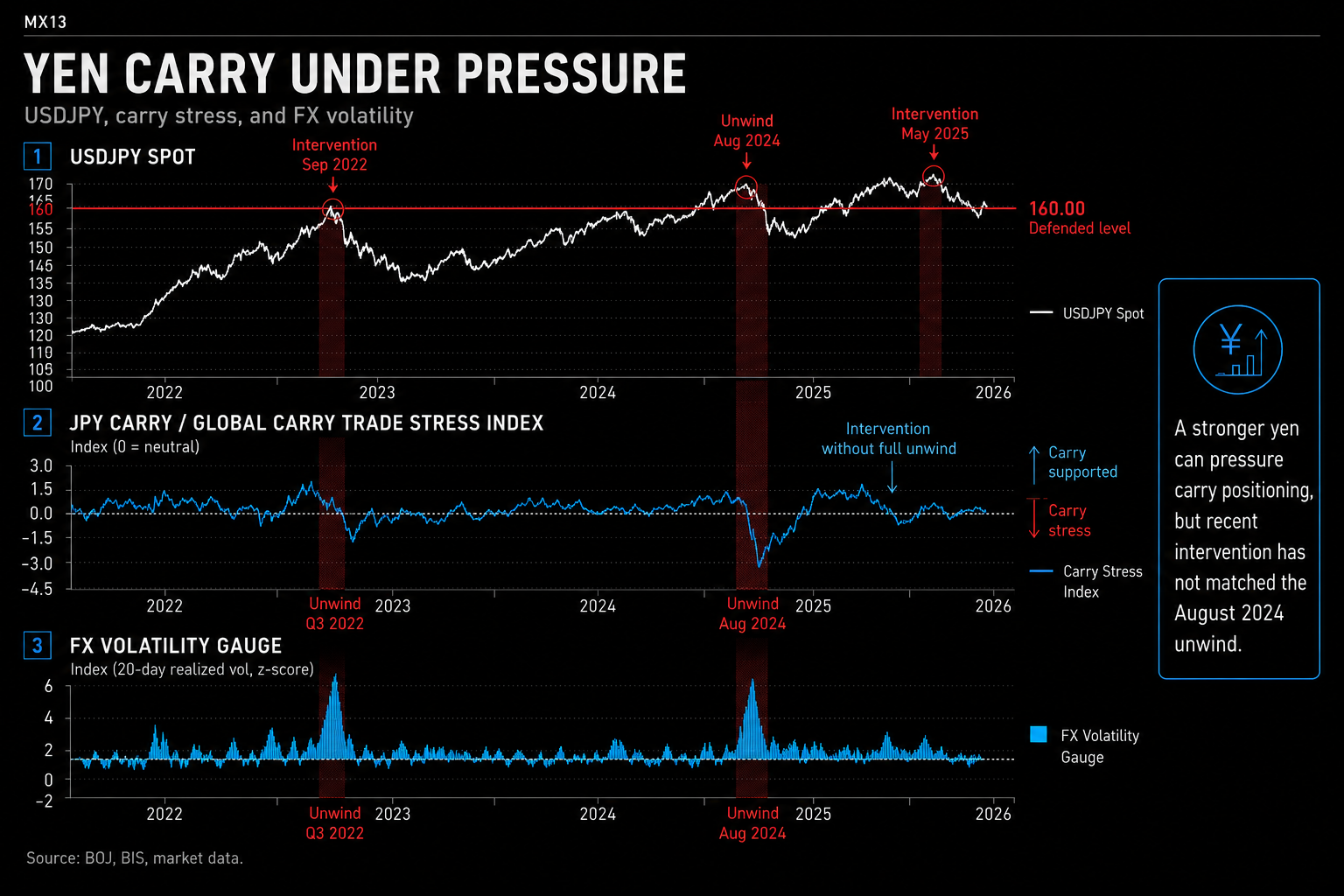
A broader risk-off event occurring alongside yen strength would attack both sides of the carry trade. The risk asset purchased with borrowed capital would decline, while the yen liability used to fund it would become more expensive to repay. Falling collateral values would raise margin requirements, forcing investors to sell assets and buy yen.
Those purchases would strengthen the yen further, increasing losses for other participants holding similar positions. More positions would be reduced, more assets would be sold, and more yen would need to be purchased. A normal correction could turn into a reflexive liquidation moving through foreign exchange, rates, equities, credit, commodities, and crypto.
Fundamentals temporarily lose control of price during that type of event. Bitcoin would be sold because it is liquid, volatile, and widely used as collateral. Gold could be sold despite a strong long-term outlook because investors sell what they can to meet margin calls. Correlations approach one when portfolios stop expressing individual views and begin raising cash.
Low FX and rate volatility make the setup more dangerous because subdued historical risk measures allow leverage to grow. The longer the calm persists, the larger the potential adjustment when the funding regime changes. A yen unwind is not our immediate base case, but it is the strongest reason not to treat a gold or Bitcoin breakout as invulnerable.
Own Hard Assets
The hard-asset thesis does not depend on predicting the exact language used at Jackson Hole, the timing of the next policy shift, or the precise low in Bitcoin. It rests on a system with fewer acceptable choices as policymakers attempt to finance large deficits, preserve nominal growth, manage currencies, and contain bond-market volatility without allowing inflation to accelerate. The latest QRA shows that this adaptation is already underway: Treasury has restored flexibility around coupon issuance, the Federal Reserve is supporting bill markets and reserve balances, and the long end is being allowed to impose tighter financial conditions while the policy rate remains comparatively stable.
Gold is the more mature expression of this regime. It has absorbed a positioning reset, war-driven liquidation, elevated real rates, hawkish policy, and persistent weakness in long-duration bonds without losing its structural bid. Bitcoin remains the higher-beta expression, having spent months accumulating while realized and implied volatility compress toward historic extremes. Both assets can still decline during a delivered hiking cycle or global deleveraging event, but the broader allocation case remains intact as nominal liabilities expand and policymakers become more involved in the markets required to finance them.
MX13 has been long gold and gold miners since gold traded near $4,000 and GDX traded near $70. Those positions are already materially profitable, but we continue to look for opportunities to increase exposure rather than treat the current move as complete. We have also been gradually accumulating Bitcoin in the low-$60,000 region and expect to add at higher prices if the market breaks out and establishes sustained acceptance above $70,000. Gold is already pricing the policy constraint. Bitcoin is approaching confirmation of the next expansion. We intend to own both.