
This report goes into how agentic commerce shifts digital commerce away from interface-led shopping and toward continuous, system-led optimization. It examines the limits of the existing interface economy, the role of execution infrastructure, Tempo as one example of that infrastructure, and the pressure this change could place on established digital-commerce models.
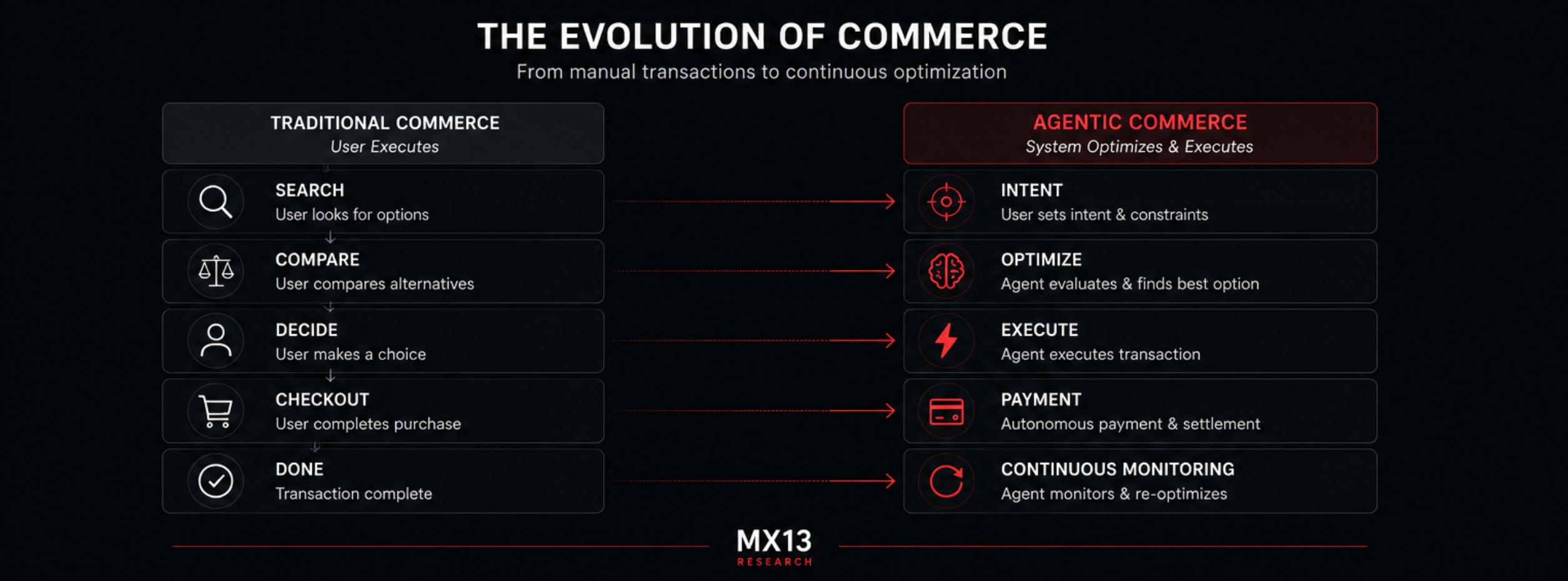
For most of the internet era, commerce has depended on human attention. Platforms compete to capture the user, present inventory, influence the decision, and guide the user through checkout. Agentic commerce changes that structure by moving the user from manual executor to source of intent. The user defines preferences and constraints; the system searches, evaluates, optimizes, executes, and continues monitoring the decision over time. Commerce moves beyond isolated transactions and begins to operate as a continuous optimization loop.
The Interface Economy
Modern digital commerce is still built around human interaction. To buy a product, book travel, manage subscriptions, or compare services, users move through a fragmented sequence of interfaces. Someone shopping for a product may open Amazon, filter results, read reviews, compare prices, evaluate shipping times, and complete checkout manually. A traveler may search across several booking platforms, weigh price against convenience, enter payment information, and monitor changes after the purchase. A household managing recurring subscriptions can accumulate services over time, forget what is being billed, and rarely optimize the full monthly spend.
The internet made information and inventory more accessible than offline commerce, but it did not remove the execution burden from the user. Most commercial activity still demands time, comparison, attention, and manual decision-making. Outcomes are often suboptimal because a consumer cannot continuously monitor every market, price, subscription, booking option, or service alternative.
That structure optimizes commerce for attention rather than efficiency. The dominant platforms benefit from controlling the interface where discovery, comparison, and checkout take place. Search rankings, reviews, ads, subscriptions, promotions, and checkout flows all operate on the assumption that the human remains the final decision-maker and executor.
The Agent Economy
In an agent-driven system, that sequence of steps can collapse into intent. A user looking for a 27-inch 4K monitor under $600 optimized for Mac can state the objective instead of manually searching across platforms. The agent can compare specifications and reviews, monitor prices, account for return policies, and execute the purchase. The same framework can apply to travel, subscriptions, software procurement, insurance, household services, and eventually many other areas of consumer and enterprise spending.
The shift is larger than a more convenient search experience. Human decisions are discrete; a system can monitor continuously. A user may compare prices once before checkout, while an agent can continue assessing price, availability, service quality, delivery timing, and alternatives after the initial decision. Commerce begins to resemble portfolio management, where each position is evaluated continuously against changing constraints.
In this model, discovery becomes intent, decision-making becomes optimization, and checkout becomes execution. The transaction no longer sits at the center of the experience; it becomes one function within a system that continues searching for better outcomes.
The Missing Layer Is Execution
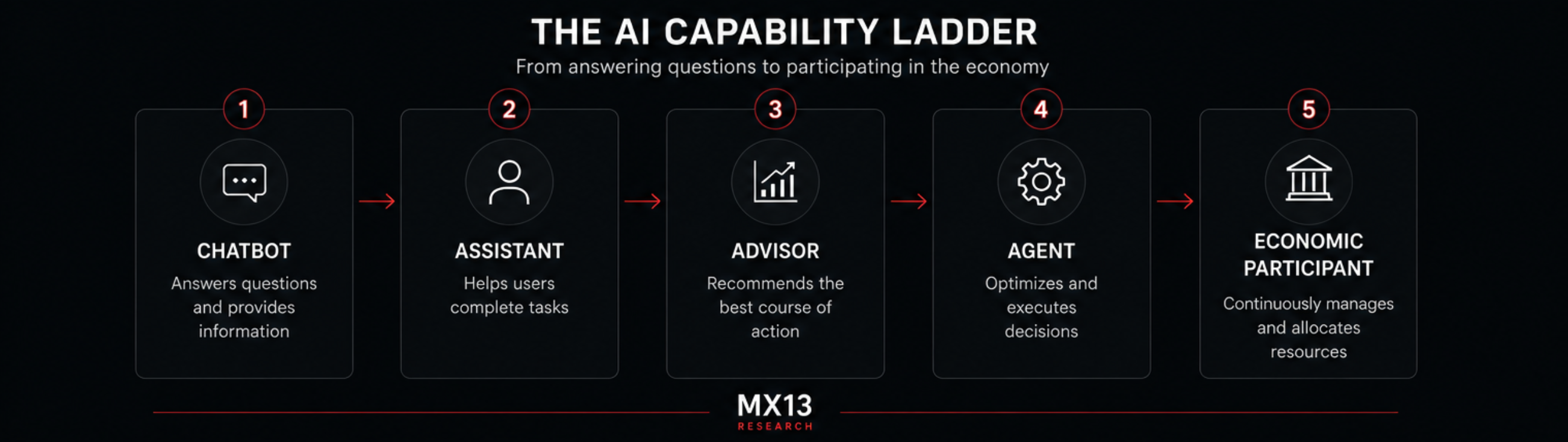
Most AI systems can recommend but cannot fully act. They can summarize options, compare products, suggest flights, or identify ways to reduce spending, but the user still completes the transaction. That keeps the human at the center of the workflow and preserves much of the friction within digital commerce.
Execution changes the role of the system. An agent that can route payments, access capital, complete transactions, manage recurring obligations, and respond as conditions change becomes an economic participant rather than an advisor. Agentic commerce then becomes more than a better interface; it becomes a transaction layer.
Making that possible requires programmable payment infrastructure, permissioned capital, identity and authorization systems, real-time settlement, and reliable transaction routing. Agents also need rules governing what they can buy, how much they can spend, when they can act independently, and when they must ask for approval. The value of an agent rests on more than the quality of its recommendation. It also depends on whether that recommendation can become a transaction safely, quickly, and reliably.
Tempo and the Agent-Native Execution Layer
Tempo is one example of the infrastructure that could matter in this transition. It is a new blockchain network designed around payments and stablecoin settlement, backed by major crypto and fintech participants including Stripe and Paradigm. Its relevance is not that it is another payments chain. It points to the execution infrastructure autonomous agents may require.
In an agent-native environment, payments become a programmable function inside a broader optimization system rather than the final step of a transaction. An execution layer such as Tempo can allow agents to access capital, route transactions, execute payments, and manage ongoing commercial activity. Agentic commerce therefore needs more than intelligence at the application layer; it needs infrastructure that can turn decisions into transactions.
A chatbot may identify a cheaper subscription plan, but the existing friction remains if the user still has to log in, navigate settings, cancel the old plan, select the new one, verify payment, and monitor future billing. An agent that completes the full workflow operates within a different economic model. The same logic applies to travel, procurement, software spending, insurance, energy usage, financial services, and other categories where decisions can be optimized over time.
Market Implications
Agentic commerce can weaken the traditional interface moat. A platform that previously won because users began their search there can lose some of that power if agents compare across multiple platforms automatically. Search, discovery, advertising, and checkout flows become less defensible when users are no longer manually navigating them.
The same shift can pressure margins. Many digital commerce businesses benefit from consumer inertia, search friction, opaque pricing, and the difficulty of constant comparison. Agents reduce those frictions by identifying cheaper alternatives, canceling unused subscriptions, comparing vendors, and routing demand toward the best available outcome. Pricing power can compress across categories that were once protected by convenience or user neglect.
New moats can emerge at the same time. Optimization depends on accurate pricing, inventory, availability, service reliability, and user-preference data. Speed and reliability also become more valuable because autonomous commerce requires execution systems that work consistently at scale. A failed transaction, delayed booking, or incorrect purchase creates trust issues that can limit adoption. As commerce becomes more continuous, latency and reliability begin to matter in ways that resemble financial infrastructure.
Subscription models are particularly exposed. A meaningful portion of the subscription economy benefits from passive retention: users forget, delay cancellation, or tolerate small recurring costs because the effort required to optimize them exceeds the perceived savings. Agents change that equation. If recurring spend can be reviewed, canceled, downgraded, or rotated automatically, the durability of many consumer subscription models can weaken.
Conclusion
Agentic commerce shifts digital commerce from interface-driven transactions to system-level optimization. The opportunity is likely to concentrate less in front-end applications and more in the infrastructure that allows agents to transact autonomously. Payment rails, credit systems, identity, authorization, settlement, and real-time data access all become more relevant as AI moves from recommendation toward execution.
The companies that control agent distribution may also become powerful because they control user intent. If a consumer trusts one agent to manage purchases, subscriptions, travel, software, financial products, and household services, that agent becomes the new starting point for commerce. Downstream platforms may still provide inventory, services, and fulfillment, but the primary relationship could shift toward the agent layer.
Agentic commerce draws on AI, financial infrastructure, and programmable capital. AI creates the decision layer, payment rails create the execution layer, and data networks create the optimization layer. That combination allows commerce to move from something users manually perform into something autonomous systems continuously manage, increasing efficiency, optimization, and purpose for consumers.